


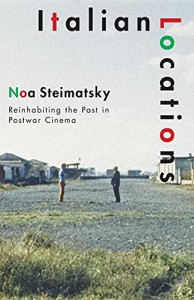
Italian Locations
Reinhabiting the Past in Postwar Cinema


 (0 vote)
Average rating:
| 0 | rating |  = We can do without = We can do without |
| 0 | rating |  = Good book = Good book |
| 0 | rating |  = Excellent book = Excellent book |
| 0 | rating |  = Unique / a reference = Unique / a reference |
Your rating: -
Book Presentation:
Fascism and the Second World War left Italy indelibly changed, and cinema was arguably the art that most rigorously confronted the devastated nation. In this examination of four Italian filmmakers, Noa Steimatsky brilliantly maps their forceful negotiation of Italy’s identity and posits that the cinematic forms they employ constitute an imaginary reinhabiting of Italy-one that is inextricably linked with the political, physical, and symbolic predicament of reconstruction.
A dynamic intersection of pictorial and photographic, architectural and literary discourses inform Steimatsky’s revisionist interrogation of exemplary works from the 1940s to the mid–1960s. From the earliest documentary work of Michelangelo Antonioni on the River Po to Pier Paolo Pasolini’s re-siting of the Gospel in the arid, peripheral landscape of the Italian south, and from Roberto Rossellini’s tracing of a neorealist project in ruinous Berlin to Luchino Visconti’s wrought grandeur visited upon a humble Sicilian fishing village, Italian Locations probes the historical experience of displacement, anachronism, and a thoroughly contemporary anxiety in the cinematic arena.
For Steimatsky, Antonioni’s modernist achievement, informed by his native landscape, Rossellini’s neorealist image of Italy as a nation of ruins, Visconti’s reaching back to the nineteenth century and even more archaic pasts, and Pasolini’s ambivalence about modernity-all partake in a search for a politically and culturally redeemed Italy.
Noa Steimatsky is associate professor of the history of art and film studies at Yale University.
> From the same author:
> On a related topic:
Scoring Italian Cinema (2025)
Patterns of Collaboration
Dir. Giorgio Biancorosso and Roberto Calabretto

Screening Religions in Italy (2019)
Contemporary Italian Cinema and Television in the Post-Secular Public Sphere

Dreamscapes in Italian Cinema (2019)
Dir. Francesco Pascuzzi and Bryan Cracchiolo
Masculinity and Italian Cinema (2014)
Sexual Politics, Social Conflict and Male Crisis in the 1970s
The Transatlantic Gaze (2014)
Italian Cinema, American Film
Brutal Vision (2012)
The Neorealist Body in Postwar Italian Cinema

 Back
Back

