


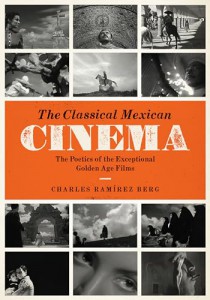
The Classical Mexican Cinema
The Poetics of the Exceptional Golden Age Films


 (0 vote)
Average rating:
| 0 | rating |  = We can do without = We can do without |
| 0 | rating |  = Good book = Good book |
| 0 | rating |  = Excellent book = Excellent book |
| 0 | rating |  = Unique / a reference = Unique / a reference |
Your rating: -
Book Presentation:
From the mid-1930s to the late 1950s, Mexican cinema became the most successful Latin American cinema and the leading Spanish-language film industry in the world. Many Cine de Oro (Golden Age cinema) films adhered to the dominant Hollywood model, but a small yet formidable filmmaking faction rejected Hollywood’s paradigm outright. Directors Fernando de Fuentes, Emilio Fernández, Luis Buñuel, Juan Bustillo Oro, Adolfo Best Maugard, and Julio Bracho sought to create a unique national cinema that, through the stories it told and the ways it told them, was wholly Mexican. The Classical Mexican Cinema traces the emergence and evolution of this Mexican cinematic aesthetic, a distinctive film form designed to express lo mexicano.
Charles Ramírez Berg begins by locating the classical style’s pre-cinematic roots in the work of popular Mexican artist José Guadalupe Posada at the turn of the twentieth century. He also looks at the dawning of Mexican classicism in the poetics of Enrique Rosas’ El Automóvil Gris, the crowning achievement of Mexico’s silent filmmaking era and the film that set the stage for the Golden Age films. Berg then analyzes mature examples of classical Mexican filmmaking by the predominant Golden Age auteurs of three successive decades. Drawing on neoformalism and neoauteurism within a cultural studies framework, he brilliantly reveals how the poetics of Classical Mexican Cinema deviated from the formal norms of the Golden Age to express a uniquely Mexican sensibility thematically, stylistically, and ideologically.
About the Author:
Charles Ramírez Berg is Joe M. Dealy, Sr. Professor in Media Studies at the University of Texas at Austin, where he has won every major teaching award. He is the author of several books, including Latino Images in Film: Stereotypes, Subversion, and Resistance and Cinema of Solitude: A Critical Study of Mexican Film, 1967–1983.
Press Reviews:
The Classical Mexican Cinema is a gorgeous book, so full of stills and frame blowups deftly illustrating Berg’s narrative that it is an immersive experience…An invaluable resource for all students and lovers of cinema, this book would also make a superb course text. Choice
Ramírez Berg explores the roots of the industry and explains how filmmakers of the time crafted a style that was distinctly Mexican. New York Times
An ambitious book that recognizes and defines the enduring presence of a ‘Mexican’ way of producing cinematic realities. One of the greatest strengths of The Classical Mexican Cinema is that it integrates both visual and textual analysis. This approach makes the book brilliant, solid, and very attractive. Fernando Fabio Sánchez, Assistant Professor of Spanish, California Polytechnic State University, and author of Artful Assassins: Murder as Art in Modern Mexico and La luz y la guerra: El cine de la Revolución Mexicana
> From the same author:
Cinema of Solitude (2009)
A Critical Study of Mexican Film, 1967-1983
> On a related topic:
Spectacle Every Day / Espectáculo a diario (2023)
Essays on classical Mexican cinema 1940-1969
Dir. Díaz de la Vega Alonso and Jorge Javier Negrete Camacho
(in English and Spanish)
Woman-Centered Brazilian Cinema (2023)
Filmmakers and Protagonists of the Twenty-First Century
Dir. Jack A. Draper III and Cacilda M. Rêgo
The Lost Cinema of Mexico (2022)
From Lucha Libre to Cine Familiar and Other Churros
Dir. Olivia Cosentino and Brian Price
The White Indians of Mexican Cinema (2022)
Racial Masquerade throughout the Golden Age
Mexico Unmanned (2022)
The Cultural Politics of Masculinity in Mexican Cinema
Tastemakers and Tastemaking (2021)
Mexico and Curated Screen Violence
 Back
Back

