

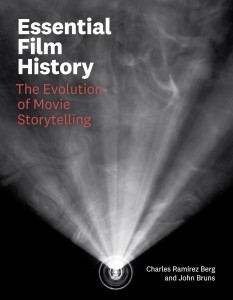
Essential Film History
The Evolution of Movie Storytelling
de Charles Ramírez Berg et John Bruns


 (0 vote)
Moyenne des votes :
| 0 | vote |  = On peut s'en passer |
| 0 | vote |  = Bon livre |
| 0 | vote |  = Excellent livre |
| 0 | vote |  = Unique / une référence |
Votre vote : -
Description de l'ouvrage:
A guide to the fundamentals of understanding film history, filmmaking, and film appreciation.
Film is not just a medium; it is also a language―and a global one at that. Essential Film History describes how this language emerged and how it has matured over the course of more than 125 years. Beginning with the experiments of the late nineteenth century, and tracking the development of cinematic storytelling, commercial distribution, and audience reception into the era of digital recording, Charles Ramírez Berg and John Bruns offer a comprehensive course in both the history and artistry of film.
Essential Film History breaks cinematic language into three core components: image, sound, and narrative. Between the 1890s and 1940s, this audiovisual language both consolidated and spread, becoming comprehensible worldwide. Since then, filmmakers have adapted and extended the language of cinema to suit an ever-growing range of aesthetic and narrative projects, from documentaries and full-length animation to avant-garde and made-for-TV movies. Covering major figures, studios, and events as well as key technological and sociopolitical developments, Essential Film History is an indispensable guide to the evolution of cinematic style.
À propos des auteurs :
Charles Ramírez Berg is the Joe M. Dealey, Sr. Professor in Media Studies at the University of Texas at Austin. He is the author of The Classical Mexican Cinema: The Poetics of the Exceptional Golden Age Films and Latino Images in Film: Stereotypes, Subversion, and Resistance.John Bruns is Professor of Film Studies and a faculty affiliate of the Women's and Gender Studies program at the College of Charleston. He is the author of Loopholes: Reading Comically and Hitchcock’s People, Places, and Things.
Voir le site internet de l'éditeur University of Texas Press
> Des mêmes auteurs :

The Classical Mexican Cinema (2015)
The Poetics of the Exceptional Golden Age Films
Cinema of Solitude (2009)
A Critical Study of Mexican Film, 1967-1983
> Sur un thème proche :
The Voice of Technology (2018)
Soviet Cinema's Transition to Sound, 1928–1935
Sujet : History of Cinema
Cinema's Conversion to Sound (2005)
Technology and Film Style in France and the U.S.
Sujet : History of Cinema

You Ain't Heard Nothin' Yet (2000)
The American Talking Film, History and Memory, 1927-1949
Sujet : History of Cinema


Making Stereo Fit (2024)
The History of a Disquieting Film Technology
Movies, Songs, and Electric Sound (2019)
Transatlantic Trends

Sounding Modernism (2017)
Rhythm and Sonic Mediation in Modern Literature and Film
Dir. Julian Murphet, Helen Groth et Penelope Hone
 Retour


