


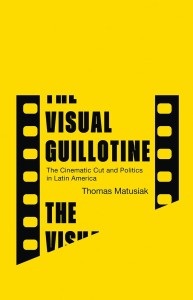
The Visual Guillotine
The Cinematic Cut and Politics in Latin America


 (0 vote)
Average rating:
| 0 | rating |  = We can do without |
| 0 | rating |  = Good book |
| 0 | rating |  = Excellent book |
| 0 | rating |  = Unique / a reference |
Your rating: -
Book Presentation:
The violence of the cinematic cut in twentieth-century Latin American film
Splice, montage, close-up: modern cinema routinely presents bodies in pieces. Not unlike the guillotine, argues Thomas Matusiak, these techniques have served both overt and symbolic political ends as they accomplish and project the efficient production of severed bodies. In The Visual Guillotine, Matusiak traces the use of cinematic tools of dismemberment in twentieth-century Latin American film to theorize the symbolic and material violence of the cut.
A robust genealogy of Latin American cinematic politics, The Visual Guillotine encompasses national filmmaking traditions; radical and reactionary political registers; and the proliferated aesthetics of narrative, documentary, experimental, and expanded cinema through an innovative critical viewing practice. From the national cinemas of the 1930s to the decapitation videos produced in the Mexican narco-conflict and beyond, Matusiak shows how the cinematic cut has been employed to inspire terror as well as invoke and critique a range of political programs.
A refreshing dialogue between film theory and Latin American cultural studies, The Visual Guillotine offers a new way for film to conceptualize politics. In our present political moment, with rapidly generated and circulated visual media central to a resurgent leftist-populist battle against oligarchy and authoritarianism, this book calls for readers to reassess their viewing position when confronted with violent imagery.
Retail e-book files for this title are screen-reader friendly with images accompanied by short alt text and/or extended descriptions.
About the Author:
Thomas Matusiak is assistant professor of Latin American cultural studies in the Michele Bowman Underwood Department of Modern Languages and Literatures at the University of Miami.
Press Reviews:
"Beautifully written and meticulously argued, The Visual Guillotine fills a significant void in Latin American literary and cultural studies and film studies. Articulating a political theory of the moving image, Thomas Matusiak mobilizes cinematic form to expose film’s constitutive violence and its broader ethical and political consequences." ―Erin Graff Zivin, University of Southern California
"The Visual Guillotine is a work of great theoretical boldness and conceptual originality, providing new ways to think about the intersections between film form, technique, and the various violences underlying cinema and culture, by one of the most exciting new voices in Latin American film studies." ―Ignacio M. Sánchez Prado, author of Screening Neoliberalism: Transforming Mexican Cinema, 1988–2012
> On a related topic:
Transnational Cinema Solidarity (2025)
Chilean Exile Film and Video after 1973
Subject: Countries > Latin America
Political Documentary Cinema in Latin America (2024)
Dir. Antonio Traverso and Kristi Wilson
Subject: Countries > Latin America

Revolutionary Visions (2020)
Jewish Life and Politics in Latin American Film
Subject: Countries > Latin America
Indianizing Film (2009)
Decolonization, the Andes, and the Question of Technology
by Freya Schiwy
Subject: Countries > Latin America

Where Social Identities Converge (2024)
Latin American and Latinx Youth on Screen
Subject: Countries > Latin America

Struggles for Recognition (2021)
Melodrama and Visibility in Latin American Silent Film
Subject: Countries > Latin America

Cinema between Latin America and Los Angeles (2019)
Origins to 1960
Dir. Jan-Christopher Horak, Lisa Jarvinen and Colin Gunckel
Subject: Countries > Latin America

Politics of Children in Latin American Cinema (2019)
Dir. María Soledad Paz-MacKay and Omar Rodriguez
Subject: Countries > Latin America

The Feeling Child (2018)
Affect and Politics in Latin American Literature and Film
Dir. Philippa Page, Inela Selimovic and Camilla Sutherland
Subject: Countries > Latin America
 Back


