


Revolutionary Visions
Jewish Life and Politics in Latin American Film

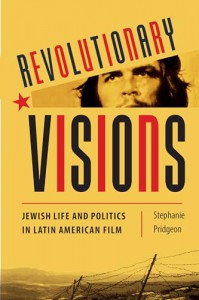

 (0 vote)
Moyenne des votes :
| 0 | vote |  = On peut s'en passer = On peut s'en passer |
| 0 | vote |  = Bon livre = Bon livre |
| 0 | vote |  = Excellent livre = Excellent livre |
| 0 | vote |  = Unique / une référence = Unique / une référence |
Votre vote : -
Description de l'ouvrage:
Revolutionary Visions examines recent cinematic depictions of Jewish involvement in 1960s and 1970s revolutionary movements in Latin America. In order to explore the topic, the book bridges critical theory on religion, politics, and hegemony from regional Latin American, national, and global perspectives. Placing these theories in dialogue with recent films, the author asks the following questions: How did revolutionary commitment change Jewish community and families in twentieth-century Latin America? How did Jews contribute to revolutionary causes, and what is the place of Jews in the legacies of revolutionary movements? How is film used to project self-representations of Jewish communities in the national project for a mainstream audience?
Jewish involvement in revolutionary movements is rife with contradictions. On the one hand, it was a natural progression of patterns of political participation, based on the ideological affinities shared between socialist movements and Marxist revolutionary politics. On the other hand, involvement in revolutionary politics would also upset the status quo of Jewish communities because of the extreme nature of revolutionary practices (e.g., guerrilla warfare), revolutionary groups’ alignment with Palestine, and the assimilation into non-Jewish culture that revolutionary involvement often entailed. These contradictions between Jewish self-identification and revolutionary activity continue to confound cultural understandings of the points of contact between identities and political affinities. In this way, Revolutionary Visions contributes to timely debates within cultural studies surrounding identities and politics.
À propos de l'auteur :
Stephanie M. Pridgeon is an associate professor of Hispanic studies at Bates College.
Voir le site internet de l'éditeur University of Toronto Press
> Sur un thème proche :

Slave Revolt on Screen (2021)
The Haitian Revolution in Film and Video Games

Transnational Cinema Solidarity (2025)
Chilean Exile Film and Video after 1973
Sujet : Countries > Latin America
Political Documentary Cinema in Latin America (2024)
Dir. Antonio Traverso et Kristi Wilson
Sujet : Countries > Latin America

Indianizing Film (2009)
Decolonization, the Andes, and the Question of Technology
de Freya Schiwy
Sujet : Countries > Latin America

Hollywood in Havana (2019)
US Cinema and Revolutionary Nationalism in Cuba before 1959
de Megan Feeney
Sujet : Countries > Latin America

Screening Cuba (2010)
Film Criticism As Political Performance During the Cold War
de Hector Amaya
Sujet : Countries > Latin America

Cinema and the Sandinistas (2003)
Filmmaking in Revolutionary Nicaragua
Sujet : Countries > Latin America

The Cinematic Tango (2006)
Contemporary Argentine Film

Precarious Secrets (2025)
A History of the Latin American Political Thriller
 Retour

