


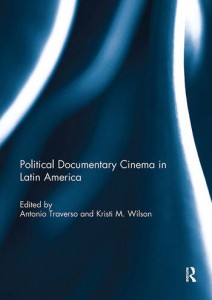
Political Documentary Cinema in Latin America
Edited by Antonio Traverso and Kristi Wilson


 (0 vote)
Average rating:
| 0 | rating |  = We can do without = We can do without |
| 0 | rating |  = Good book = Good book |
| 0 | rating |  = Excellent book = Excellent book |
| 0 | rating |  = Unique / a reference = Unique / a reference |
Your rating: -
Book Presentation:
The chapters in this book show the important role that political documentary cinema has played in Latin America since the 1950s. Political documentary cinema in Latin America has a long history of tracing social injustice and suffering, depicting political unrest, intervening in periods of crisis and upheaval, and reflecting upon questions about ideology, cultural identity, genocide and traumatic memory. This collection bears witness to the region's film culture's diversity, discussing documentaries about workers' strikes, riots, and military coups against elected governments; crime, poverty, homelessness, prostitution, children's work, and violence against women; urban development, progress, (under)development, capitalism, and neoliberalism; exile, diaspora and border cultures; trauma and (post)memory. The chapters focus on documentaries made in Argentina, Brazil, Chile, Cuba, Mexico, and Venezuela, as well as on the work of Latino and diasporic Latin American political documentarians. The contributors to the anthology reflect the cultural and linguistic diversity of current Latin American film scholarship, with some writing in Spanish and Portuguese from Argentina and Brazil (with their original works especially translated), and others writing in English from Australia, Europe, and the USA.
This book was originally published as a special issue of Social Identities.
About the authors:
Antonio Traverso is Senior Lecturer in Film Studies, Curtin University, Australia. He is the co-editor of ‘Political Documentary Cinema in the Southern Cone’ (2013, special issue of Latin American Perspectives), Interrogating Trauma (2011), and Living Through Terror (2011). Kristi M. Wilson is an Assistant Professor of Rhetoric and Composition and Affiliate Assistant Professor of Humanities at Soka University of America, USA. She is the co-editor of Italian Neorealism and Global Cinema (2007) and Film and Genocide (2012).
See the publisher website: Routledge
> From the same authors:
Screen Culture in the Global South (2024)
Cinema at the End of the World
Dir. Antonio Traverso, Deane Williams and Keyan G. Tomaselli
> On a related topic:
Transnational Cinema Solidarity (2025)
Chilean Exile Film and Video after 1973
Subject: Countries > Latin America
Revolutionary Visions (2020)
Jewish Life and Politics in Latin American Film
Subject: Countries > Latin America
Indianizing Film (2009)
Decolonization, the Andes, and the Question of Technology
by Freya Schiwy
Subject: Countries > Latin America

Cinematic nightscapes (2026)
Documentary and ethnographic filmmaking in Cuba
by Eleonora Diamanti and Alexandrine Boudreault-Fournier
Subject: Countries > Latin America
Cinematic Journeys in Latin America (2023)
Geography Through the Lens of Exploration and Discovery Films
Subject: Countries > Latin America
New Documentaries in Latin America (2014)
by Vinicius Navarro and Juan Carlos Rodríguez
Subject: Countries > Latin America
The Cinematic Tango (2006)
Contemporary Argentine Film
Precarious Secrets (2025)
A History of the Latin American Political Thriller
 Back
Back

