


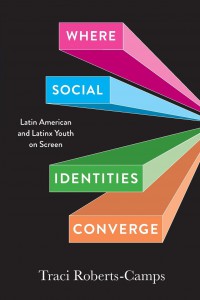
Where Social Identities Converge
Latin American and Latinx Youth on Screen


 (0 vote)
Average rating:
| 0 | rating |  = We can do without = We can do without |
| 0 | rating |  = Good book = Good book |
| 0 | rating |  = Excellent book = Excellent book |
| 0 | rating |  = Unique / a reference = Unique / a reference |
Your rating: -
Book Presentation:
Where Social Identities Converge examines adolescent girlhood as a metaphorical site in Latin American and Latinx film. Author Traci Roberts‑Camps analyzes the work of a series of female directors from Argentina, Ecuador, Mexico, Peru, Venezuela, and the United States to understand how female adolescence and young adulthood are represented in film. She argues that using an intersectional lens reveals how these directors present the image of adolescent girlhood as a site of early trauma that presages women’s lived experiences with institutional, interconnected forms of oppression. The book thus considers intersectionality through young female protagonists who represent identity struggles in Latin America and US Latinx communities. In doing so, it examines a range of genres, such as fictional film, documentary, and television miniseries. Each chapter includes a close reading of specific scenes that offer insight into the young female protagonists’ multiple identity markers and a continuous comparison between chapters.
About the Author:
Traci Roberts-Camps is a professor of Latin American literature and film and chair of the Department of Modern Languages and Literature at the University of the Pacific.
Press Reviews:
"Roberts-Camps demonstrates, yet again, that she is a leading scholar of Latin American film. Where Social Identities Converge will, undoubtedly, become a touchstone for other scholars in the field. Its lively prose, one that eschews academic jargon for the sake of clarity, makes it an ideal text for students and scholars alike."
—Melissa A. Fitch, author of Global Tangos: Travels in the Transnational Imaginary
> From the same author:

Latin American Women Filmmakers (2017)
Social and Cultural Perspectives
Subject: Countries > United States
> On a related topic:

New Visions of Adolescence in Contemporary Latin American Cinema (2018)
Dir. Geoffrey Maguire and Rachel Randall
Subject: Countries > Latin America

Children on the Threshold in Contemporary Latin American Cinema (2017)
Nature, Gender, and Agency
Subject: Countries > Latin America

Struggles for Recognition (2021)
Melodrama and Visibility in Latin American Silent Film
Subject: Countries > Latin America

Cinema between Latin America and Los Angeles (2019)
Origins to 1960
Dir. Jan-Christopher Horak, Lisa Jarvinen and Colin Gunckel
Subject: Countries > Latin America

Politics of Children in Latin American Cinema (2019)
Dir. María Soledad Paz-MacKay and Omar Rodriguez
Subject: Countries > Latin America

The Feeling Child (2018)
Affect and Politics in Latin American Literature and Film
Dir. Philippa Page, Inela Selimovic and Camilla Sutherland
Subject: Countries > Latin America

Down Syndrome Culture (2024)
Life Writing, Documentary, and Fiction Film in Iberian and Latin American Contexts
Subject: Sociology

Clicas (2024)
Gender, Sexuality, and Struggle in Latina/o/x Gang Literature and Film
by Frank García
Subject: Sociology

 Back
Back

