


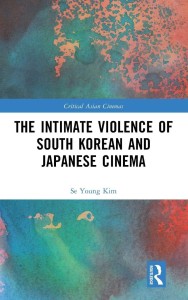
The Intimate Violence of South Korean and Japanese Cinema
by Se Young Kim


 (0 vote)
Average rating:
| 0 | rating |  = We can do without = We can do without |
| 0 | rating |  = Good book = Good book |
| 0 | rating |  = Excellent book = Excellent book |
| 0 | rating |  = Unique / a reference = Unique / a reference |
Your rating: -
Book Presentation:
This book provides an in-depth analysis of the origins and impact of violent South Korean and Japanese cinema from the late 1990s onward, exploring how South Korean filmmakers were inspired by their Japanese counterparts and reflecting shared economic struggles of the 1990s and early 2000s.
Through the concept of “intimate violence,” this book provides a critical account of violence as a means of mediating social relations and articulating the transformations of neoliberal modernity. It offers a detailed analysis of the simulated acts of violence, with particular attention to mise-en-scène, and explores their broader political and philosophical implications. This volume critiques the ubiquity of violence in commercial media and its role in shaping neoliberal sociality and personhood.
The Intimate Violence of South Korean and Japanese Cinema is essential reading for students and scholars of East Asian cinema, film and media studies, cultural studies, and political economy, as well as general readers interested in the topic.
About the Author:
Se Young Kim is an assistant professor of global cinema and digital media in the Cinema Studies Department at Colby College. His research interests include South Korean, Japanese, and US cinema and media, including videogames and streaming media, with a focus on the use of violence.
Press Reviews:
"In Se Young Kim’s innovative new book, intimate violence is nothing less than the troubled political consciousness of Korean and Japanese modernity, its uneasy mode of contradictory sociality shot through with the historical burdens of war, colonialism, and necrocapitalism, seeking to harm that which it also wants to hold close in embrace. This is a bold study that peers intently into the beating heart of contemporary East Asian popular culture and its dark entanglements."
Joseph Jonghyun Jeon, Professor of English, University of California, Irvine, and Author of Vicious Circuits: Korea’s IMF Cinema and the End of the American Century
"The Intimate Violence of South Korean and Japanese Cinema takes a hammer to our notions of shock, blood, and gore. Slashing away the notion that brutality is just spectacle, Se Young Kim shows that in films and series like Hana-bi, Oldboy, Battle Royale, and The Glory, the aesthetics of violence is a language spoken in communities with shared histories, debts, and wounds. The book offers a groundbreaking account of cultural exchange, tracing for instance how Squid Game did not arrive sui generis but emerged from a long-shared repertoire of styles, forms, and preoccupations. Kim reveals how this vision of Japanese and Korean cultural products is inseparable from the region’s experience of compressed modernity – its wrenching social transformations and broken promises. This book insists that the global appetite for this cinema is not desensitization. It is an invitation to look at ourselves."
Jonathan E. Abel, Professor of Asian Studies and Comparative Literature at Penn State University and Author of The New Real :Media and Mimesis in Japan from Stereographs to Emoji
"The Intimate Violence of South Korean and Japanese Cinema deftly situates Japan and South Korea alongside Hollywood as co-shapers of contemporary simulated violence, tracing the economic and aesthetic entanglements that drove both regional production and global circulation from the late 1990s onward. Through the concept of "intimate violence," Kim offers a novel theorization of screen brutality as a relational and representational technology put to work by media brokers navigating the pressures of compressed neoliberal modernity. At a moment when Korean Wave (Hallyu) media has achieved undeniable global reach, the book reminds scholars of contemporary media – including a game studies field still largely anchored in Western frameworks – to reckon with the longer economic, regional, and sociocultural histories that made that reach possible."
Tara Fickle, Associate Professor of Asian American Studies at Northwestern University and Author of The Race Card: From Gaming Technologies to Model Minorities
See the publisher website: Routledge
> On a related topic:
The Late and Post-Dictatorship (2025)
Cinephilia Boom and Art Houses in South Korea
The Korean War and Postmemory Generation (2023)
Contemporary Korean Arts and Films
Movie Minorities (2021)
Transnational Rights Advocacy and South Korean Cinema

Movie Migrations (2015)
Transnational Genre Flows and South Korean Cinema
Two Lenses on the Korean Ethos (2015)
Key Cultural Concepts and Their Appearance in Cinema
by Keumsil Kim Yoon and Bruce Williams

Rising Sun, Divided Land (2013)
Japanese and South Korean Filmmakers
Pop Empires (2019)
Transnational and Diasporic Flows of India and Korea
Dir. S. Heijin Lee, Monika Mehta and Robert Ji-Song Ku

 Back
Back

