

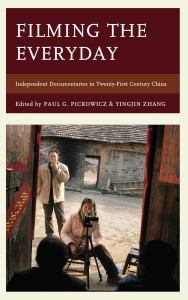
Filming the Everyday
Independent Documentaries in Twenty-First-Century China
Sous la direction de Paul G. Pickowicz et Yingjin Zhang


 (0 vote)
Moyenne des votes :
| 0 | vote |  = On peut s'en passer = On peut s'en passer |
| 0 | vote |  = Bon livre = Bon livre |
| 0 | vote |  = Excellent livre = Excellent livre |
| 0 | vote |  = Unique / une référence = Unique / une référence |
Votre vote : -
Description de l'ouvrage:
This cutting-edge book examines the rapidly developing scene of Chinese independent documentary, arguably the most courageous player in contemporary Chinese visual culture. The authors explore two areas that are of special interest to China studies and film studies, respectively: (1) filming the everyday in twenty-first-century China to foreground contestation and diversity and (2) exploring the aesthetic of remembering in an embodied documentary practice, which turns the gaze on artists themselves and encourages the viewer’s engagement with the filmed subjects and environment. Highlighting documentary contestation in China, the book traces its cacophony of expressions, some of it featuring confrontations with domineering elites, some of it highlighting negotiations among the independent filmmakers themselves. Their goal is not a “movement” that seeks to establish and impose a single truth, but rather a creative dynamic that fosters a community of tolerance and respects diverse forms of expression. Independent documentary is quite literally a moving target that is witnessing ongoing and widening diversity and complexity when it comes to directors, themes, aesthetics, human subjects, audiences, and impact. The authors stress the enormous potential of cultural production that features non-elites (including amateurs) and that dwells on the everyday, the bottom up, the grassroots, the seemingly mundane, and the apparently marginal. The book’s emphasis on contemporary issues and its discussion of aesthetic experiments will appeal to all readers interested in China’s culture, media, politics, and society.
À propos des auteurs :
Paul G. Pickowicz is Distinguished Professor Emeritus of History and Chinese Studies at the University of California, San Diego. Yingjin Zhang is Distinguished Professor of Literature and Chinese Studies at the University of California, San Diego.
Revue de Presse:
"Praise for From Underground to Independent:
A welcome addition to scholarship on contemporary non-state Chinese filmmaking and its context both in China and globally. . . . This accessible book should appeal to a broad audience. Highly Recommended." ―Choice Reviews
"Praise for From Underground to Independent:
A useful collection, with a good balance of established and emerging academic talent amongst its authors. . . . The book offers a readable and stimulating set of thoughts on the meaning of independence in a post-Mao cinematic environment, on the continuities of style and narrational techniques across Chinese film history, and on the ways in which film articulates the delicate play between ideas of freedom and the realities of control in contemporary China." ―China Review
"Given the increasing restrictions on the public sphere in China, the unofficial voices represented by independent documentary filmmakers have become a major source for understanding China's past and present, and they serve as a crucial corrective to the uniformity of state-sanctioned packaging of the historical and everyday realities of grassroots China. In honoring the very considerable achievements of Wu Wenguang's commitment to promoting amateur and community voices that are distinct from 'official China' or elite intellectuals, this volume introduces readers to the richness, diversity, and complexity of a China seldom visible from other sources. It builds upon the previous excellent work by Pickowicz and Zhang and should be of great interest to anyone in Chinese studies or film studies." ―Stanley Rosen, University of Southern California
"If you wanted to understand the actual conditions inside a large American corporation, would you look to an expensive infomercial from the office of the CEO or to amateur footage from the cell phones of dozens of unorganized but concerned employees? There is a parallel in China, where makers of independent documentary films are revealing unrehearsed life that state-sponsored film, by its nature, is obliged to conceal. China-watchers take note." ―Perry Link, University of California, Riverside
> Des mêmes auteurs :
Screening China (2001)
Critical Interventions, Cinematic Reconfigurations, and the Transnational Imaginary in Contemporary Chinese Cinema
> Sur un thème proche :
'My' Self on Camera (2018)
First Person Documentary Practice in an Individualising China
DV-Made China (2015)
Digital Subjects and Social Transformations After Independent Film
de Zhang Zhen et Angela Zito


A Fly in the Curry (2016)
Independent Documentary Film in India
 Retour