


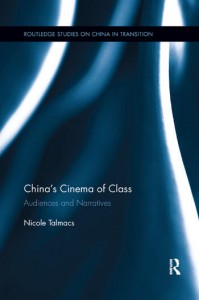
China's Cinema of Class
Audiences and Narratives


 (0 vote)
Average rating:
| 0 | rating |  = We can do without = We can do without |
| 0 | rating |  = Good book = Good book |
| 0 | rating |  = Excellent book = Excellent book |
| 0 | rating |  = Unique / a reference = Unique / a reference |
Your rating: -
Book Presentation:
China’s commercial film industry can be used as a map to understand how class is interwoven into the imaginations that inform and influence social change in Chinese society. Film consumption is important in this process, particularly for young adult urbanites that are China’s primary commercial cinema patrons.
This book investigates the web between the representation of class themes in Chinese film narratives, local audience reception to these films, and the socialisation of China’s contemporary class society. Bringing together textual analyses of narratives from five commercially exhibited films: Let the Bullets Fly (Jiang: 2010), Lost on Journey (Yip: 2011), Go Lala Go! (Xu: 2011), House Mania (Sun: 2011) and The Piano in the Factory (Zheng: 2011); and the reception of 179 Chinese audiences from varying class positions, it investigates the extent to which fictional narratives inform and reflect current class identities in present-day China. Through group discussions in Beijing, Hangzhou, Nanjing, Lanzhou and Taiyuan, the author searches for audiences beyond major cities that are typically the focus of film consumption studies in China. As such, the book reveals not only how deeply and widespread the socialisation of China’s class society has become in the imaginations of Chinese audiences, but also what appears to be a preference of both audiences and filmmakers for the continuation of China’s new class society.
Revealing the extent to which cinema continues to play a key role in the socialisation of class structures in contemporary Chinese society, this book will be important for students and scholars of Chinese Studies, Film Studies, Communication Studies, as well as observers of China’s film industry.
About the Author:
Nicole Talmacs is a Lecturer in Media and Communication at Xi’an Jiaotong-Liverpool University, China.
See the publisher website: Routledge
> On a related topic:

Ethnic Minority Children in Post-Socialist Chinese Cinema (2021)
Allegory, Identity, and Geography
by Zhenhui Yan
Urban Horror (2020)
Neoliberal Post-Socialism and the Limits of Visibility
DV-Made China (2015)
Digital Subjects and Social Transformations After Independent Film
by Zhang Zhen and Angela Zito
 Back
Back

