


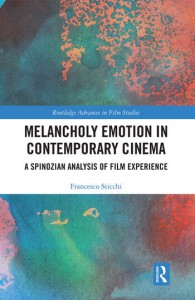
Melancholy Emotion in Contemporary Cinema
A Spinozian Analysis of Film Experience


 (0 vote)
Moyenne des votes :
| 0 | vote |  = On peut s'en passer = On peut s'en passer |
| 0 | vote |  = Bon livre = Bon livre |
| 0 | vote |  = Excellent livre = Excellent livre |
| 0 | vote |  = Unique / une référence = Unique / une référence |
Votre vote : -
Description de l'ouvrage:
This work outlines a new methodology for film analysis based on the radical materialist thought of Baruch Spinoza, re-evaluating contemporary cognitive media theory and philosophical theories on the emotional and intellectual aspects of film experience.
Sticchi’s exploration of Spinozian philosophy creates an experiential constructive model to blend the affective and intellectual aspects of cognition, and to combine it with different philosophical interpretations of film theory. Spinoza’s embodied philosophy rejected logical and ethical dualisms, and established a perfect parallelism between sensation and reason and provides the opportunity to address negative emotions and sad passions without referring exclusively to traditional notions such as catharsis or sublimation, and to put forth a practical/embodied notion of Film-Philosophy. This new analytical approach is tested on four case studies, films that challenge the viewer’s emotional engagement since they display situations of cosmic failure and depict controversial and damaged characters: A Serious Man (2009); Melancholia (2011); The Act of Killing (2012) and Only Lovers Left Alive (2013).
This book is an important addition to the literature in Film Studies, particularly in Cognitive Film Theory and Philosophy of Film. Its affective and semantic analyses of film experience (studies of embodied conceptualisation), connecting Spinoza’s thought to the analysis of audiovisual media, will also be of interest to Philosophy scholars and in academic courses of film theory, film-philosophy and cognitive film studies.
À propos de l'auteur :
Francesco Sticchi obtained a Ph.D in Film Studies at Oxford Brookes University under the supervision of Dr Warren Buckland. He works as Associate Lecturer in the same institution, and his research concerns the study of sad passions in audiovisual experience, and the relation between Spinoza’s thought and embodied cognitive theories. He is also interested in an experiential and interactive use of Mikhail Bakhtin's Chronotope, and he is currently working on an affective-ethical approach to analyse how contemporary media culture addresses the concept of precarity.
Revue de Presse:
"Sticchi commendably navigates some of the most complex philosophical writings ranging from Spinoza through cognitivism to Gilles Deleuze and back. This, in and of itself, is no mean feat, and the material Sticchi discusses is extraordinarily rich, complex, and open to a variety of interpretations." - Tarja Laine, University of Amsterdam
> Du même auteur :
The Politics of Monstrous Figures in Contemporary Cinema (2025)
Witches, Zombies, and Cyborgs Re-enchanting the Ends of the World
Mapping Precarity in Contemporary Cinema and Television (2022)
Chronotopes of Anxiety, Depression, Expulsion/Extinction
Sujet : Sociology
> Sur un thème proche :

The Structures of the Film Experience by Jean-Pierre Meunier (2019)
Historical Assessments and Phenomenological Expansions
Dir. Julian Hanich et Daniel Fairfax
Sujet : Film Analysis
Tuitions and Intuitions (2019)
Essays at the Intersection of Film Criticism and Philosophy
Sujet : Film Analysis
Jung and Film II (2011)
The Return: Further Post-Jungian Takes on the Moving Image
Dir. Christopher Hauke et Luke Hockley
Sujet : Film Analysis
Critical Terms for Media Studies (2010)
Dir. W. J. T. Mitchell et Mark B. N. Hansen
Sujet : Film Analysis
Socrates and Subtitles (2010)
A Philosopher's Guide to 95 Thought-Provoking Movies from Around the World
Sujet : Film Analysis

Jung and Film (2001)
Post-Jungian Takes on the Moving Image
Dir. Christopher Hauke et Ian Alister
Sujet : Film Analysis
 Retour

