


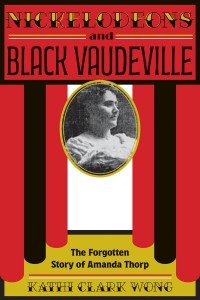
Nickelodeons and Black Vaudeville
The Forgotten Story of Amanda Thorp


 (0 vote)
Average rating:
| 0 | rating |  = We can do without = We can do without |
| 0 | rating |  = Good book = Good book |
| 0 | rating |  = Excellent book = Excellent book |
| 0 | rating |  = Unique / a reference = Unique / a reference |
Your rating: -
Book Presentation:
In an era of online streaming, it may be difficult to recognize the importance of a woman who in 1908 established the first silent movie theater in Richmond, Virginia: the Dixie nickelodeon. But Amanda Thorp, an independent, self-made woman, was on the ground floor of a popular culture that would grow to be enormously influential in our modern era. In Nickelodeons and Black Vaudeville: The Forgotten Story of Amanda Thorp, Kathi Clark Wong’s extensive archival research uncovers Thorp’s impressive contributions not only to moviegoing and its growth in America, but also perhaps even more surprisingly, Thorp’s support of early Black vaudeville in the Jim Crow South.
Movie theater entrepreneurs like Thorp, who got her start at her Wonderland Theater in Bucyrus, Ohio, helped create our culture’s insatiable appetite for film. But it was after she established the Dixie in Richmond, that Thorp—a White woman—also saw a market for providing Black-centric entertainment. She converted the Dixie to all-Black patronage and began to bring in scores of Black vaudeville acts. Later, she built the Hippodrome Theater, in the heart of Richmond’s now-historic Jackson Ward, expressly for Black entertainment. Though she eventually left the field of Black entertainment behind, Thorp developed other movie venues in Richmond that brought in tens of thousands of (White) moviegoers over the years and which were widely admired for their elaborate trappings.
Thanks to Wong’s research, contemporary readers can now benefit from the story of Amanda Thorp, a woman who amidst severe gender role constraints not only claimed social capacity on the crest of a rapidly growing industry but also, almost inadvertently, contributed to the success of early Black vaudeville, a subject which thus far has not received the scholarly attention it deserves.
About the Author:
KATHI CLARK WONG is a former journalist, political analyst, and university lecturer who is now retired and enjoys writing about her newly adopted city of Richmond, Virginia.
> On a related topic:
Marketing Modernity (2009)
Victorian Popular Shows and Early Cinema
by Joe Kember
Subject: Silent Cinema
For the Love of Pleasure (1998)
Women, Movies, and Culture in Turn-the-Century Chicago
Subject: History of Cinema
The Invention of the Spectator (2026)
How has Early film Spectatorship shaped Audience and Reception Theory:Selected Writings 1910-1920
Subject: Silent Cinema

Finding Birt Acres (2025)
The Rediscovery of a Film Pioneer
by Deac Rossell, Barry Anthony and Peter Domankiewicz
Subject: Silent Cinema

What Made Cinema? (2025)
Essays on Visual Culture and Early Film
by Ian Christie
Subject: Silent Cinema

Screening Europe in Australasia (2024)
Transnational Silent Film Before and After the Rise of Hollywood
Subject: Silent Cinema
 Back
Back

