


Doubting Vision
Film and the Revelationist Tradition

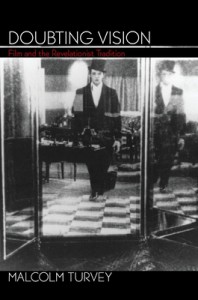

 (0 vote)
Average rating:
| 0 | rating |  = We can do without = We can do without |
| 0 | rating |  = Good book = Good book |
| 0 | rating |  = Excellent book = Excellent book |
| 0 | rating |  = Unique / a reference = Unique / a reference |
Your rating: -
Book Presentation:
The film theories of Jean Epstein, Dziga Vertov, Bela Balazs, and Siegfried Kracauer have long been studied separately from each other. In Doubting Vision, film scholar Malcolm Turvey argues that their work constitutes a distinct, hitherto neglected tradition, which he calls revelationism, and which differs in important ways from modernism and realism. For these four theorists and filmmakers, the cinema is an art of mass enlightenment because it escapes the limits of human sight and reveals the true nature of reality. Turvey provides a detailed exegesis of this tradition, pointing to its sources in Romanticism, the philosophy of Henri Bergson, modern science, and other intellectual currents. He also shows how profoundly it has influenced contemporary film theory by examining the work of psychoanalytical-semiotic theorists of the 1970s, Stanley Cavell, the modern-day followers of Kracauer and Walter Benjamin, and Gilles Deleuze.
Throughout, Turvey offers a trenchant critique of revelationism and its descendants. Combining the close analysis of theoretical texts with the philosophical method of conceptual clarification pioneered by the later Wittgenstein, he shows how the arguments theorists and filmmakers have made about human vision and the cinema's revelatory powers often traffic in conceptual confusion. Having identified and extricated these confusions, Turvey builds on the work of Epstein, Vertov, Balazs, and Kracauer as well as contemporary philosophers of film to clarify some legitimate senses in which the cinema is a revelatory art using examples from the films of filmmakers such as Alfred Hitchcock and Jacques Tati.
About the Author:
Malcolm Turvey teaches film studies at Sarah Lawrence College and is editor of the journal October.
> From the same author:
Camera Obscura, Camera Lucida (2003)
Essays in Honor of Annette Michelson
by Malcolm Turvey and Richard Allen
Subject: Theory
> On a related topic:
Interpreting Cinema (2020)
Adaptations, Intertextualities, Art Movements
by Jasbir Jain
Subject: Film Analysis
Film Theory and Criticism (2016)
Introductory Readings
Dir. Leo Braudy and Marshall Cohen
Subject: Film Analysis
Jung and Film II (2011)
The Return: Further Post-Jungian Takes on the Moving Image
Dir. Christopher Hauke and Luke Hockley
Subject: Film Analysis
 Back
Back

