


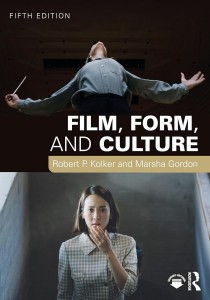
Film, Form, and Culture
by Robert Phillip Kolker and Marsha Gordon


 (0 vote)
Average rating:
| 0 | rating |  = We can do without = We can do without |
| 0 | rating |  = Good book = Good book |
| 0 | rating |  = Excellent book = Excellent book |
| 0 | rating |  = Unique / a reference = Unique / a reference |
Your rating: -
Book Presentation:
This fifth edition of Film, Form, and Culture offers a lively introduction to both the formal and cultural aspects of film.
With extensive analysis of films past and present, this textbook explores how films are constructed from part to whole: from the smallest unit of the shot to the way shots are edited together to create narrative. Robert P. Kolker and Marsha Gordon demystify the technical aspects of filmmaking and demonstrate how fiction and nonfiction films engage with culture. Over 265 images provide a visual index to the films and issues being discussed. This new edition includes: an expanded examination of digital filmmaking and distribution in the age of streaming; attention to superhero films throughout; a significantly longer chapter on global cinema with new or enlarged sections on a variety of national cinemas (including cinema from Nigeria, Senegal, Burkina Faso, South Korea, Japan, India, Belgium, and Iran); new or expanded discussions of directors, including Alice Guy-Blaché, Lois Weber, Oscar Micheaux, Agnès Varda, Spike Lee, Julie Dash, Jafar Panahi, Ava DuVernay, Jane Campion, Jean-Pierre and Luc Dardenne and Penny Lane; and new, in-depth explorations of films, including Within Our Gates (1919), Black Girl (1966), Creed (2015), Moonlight (2016), Wonder Woman (2017), Get Out (2017), Black Panther (2018), Parasite (2019), Da 5 Bloods (2020), The French Dispatch (2021), The Power of the Dog (2021), RRR (2022), and Tár (2022).
This textbook is an invaluable and exciting resource for students beginning film studies at undergraduate level.
Additional resources for students and teachers can be found on the eResource, which includes case studies, discussion questions, and links to useful websites.
About the authors:
Robert P. Kolker is Professor Emeritus at the University of Maryland, College Park, USA. He is the author/editor of several books on film including The Oxford Handbook of Film and Media Studies (2008), A Cinema of Loneliness, 4th edition (2011), The Cultures of American Film (2014), The Extraordinary Image: Orson Welles, Alfred Hitchcock, Stanley Kubrick, and the Reimagining of Cinema (2016), Politics Goes to the Movies (2018), Eyes Wide Shut: Stanley Kubrick and the Making of His Final Film (2019), and, with Nathan Abrams, Kubrick: An Odyssey (2024).Marsha Gordon is Professor and Director of Film Studies at North Carolina State University, USA. She is the author of Becoming the Ex-Wife: The Unconventional Life & Forgotten Writings of Ursula Parrott (2023), Film is Like a Battleground: Sam Fuller’s War Movies (2017), and Hollywood Ambitions: Celebrity in the Movie Age (2008), and co-editor of Screening Race in American Nontheatrical Film (2019) and Learning With the Lights Off: Educational Film in the United States (2012).
Press Reviews:
"I’ve taught Film courses for 20 years using Robert P. Kolker’s Film, Form and Culture, so I was delighted to see that Kolker has collaborated with Marsha Gordon to produce a 5th edition, which is a significant revision and expansion.
Kolker and Gordon persuasively argue that films must be taken seriously as the primary medium through which modern societies transmit their narratives and myths, in essence maintaining and extending culture.
The book offers three chapters on how movies are constructed, illustrating the principles of the art through a discussion of specific films. Most of the films under discussion are theatrically released American fictional works but attention is also devoted to documentaries and world cinema. The book presents cinema concepts like the two-shot, long take, three-point lighting, and over-the-shoulder cutting pattern in a manner that is equally interesting to casual movie-goers and future cinematographers. Kolker makes clear what is standard practice, how prior innovators have broken the rules and the success or failure of those deviations.
An additional three chapters are devoted to the history of film storytelling, focusing on the founding collaborators who created the studios, as well as the actors and the directors who created the work. While some biographical details are provided, the emphasis is on the work. There are abundant references to both the giants of the industry and their classical works like Hitchcock’s Vertigo and Psycho, Wells’ Citizen Kane, Curtiz’ Casablanca and It’s a Wonderful Life, Coppola’s Godfather and Apocalypse Now and the rest of the canon. At the same time, more recent works like Jackson’s Hobbit trilogy, the Toy Story and Hunger Games franchises, Spiderman, Black Panther and the rest of the Marvel Cinematic Universe all receive appropriate attention.
Contemporary producers and distributors like HBO and Netflix receive just as many citations as Paramount and Warner Brothers. The strengths and weaknesses of delivery media such as the movie theatre, television, videotape, DVD, 3D, and streaming services also are discussed, including the 2023 HBO series The Last of Us.
Three more chapters are devoted to the analysis of various film genres. Gangster, documentary, Western, science fiction, horror, film noir, and melodrama consume two chapters, with an additional chapter devoted to global films, in all of their varieties. The final chapter is devoted to the reciprocal relationship between film and various elements of culture, closing with additional exegesis of Vertigo.
Kolker and Gordon provide an outstanding introduction to film history, production and analysis. I am pleased that it will continue to be available for a new generation of students."- Michael R. Cunningham, Professor, Dept. of Communication, University of Louisville, USA
See the publisher website: Routledge
> From the same authors:
Kubrick (2025)
An Odyssey
by Robert Phillip Kolker and Nathan Abrams
Subject: Director > Stanley Kubrick
Becoming the Ex-Wife (2024)
The Unconventional Life and Forgotten Writings of Ursula Parrott
Subject: Others persons > Ursula Parrott
Screening Race in American Nontheatrical Film (2019)
Dir. Allyson Nadia Field and Marsha Gordon
Subject: Sociology

The Extraordinary Image (2016)
Orson Welles, Alfred Hitchcock, Stanley Kubrick, and the Reimagining of Cinema
Subject: Director > Orson Welles, Alfred Hitchcock, Stanley Kubrick
The films of Wim Wenders (1993)
cinema as vision and desire
by Robert Phillip Kolker and Peter Beicken
Subject: Director > Wim Wenders
> On a related topic:
The 12-Hour Film Expert (2024)
Everything You Need to Know about Movies
by Noah Charney and James Charney
Subject: General
A Level Film Studies (2025)
The Essential Introduction
by Sarah Casey Benyahia and John White
Subject: Film Analysis
Looking at Movies (2025)
An Introduction to Film
by Dave Monahan and Richard Barsam
Subject: Film Analysis

Cinephilia and the Adventure for Existential Health (2025)
Recomposing Subjectivity at the Cinema
Subject: Film Analysis

Film and Television Analysis (2024)
An Introduction to Methods, Theories, and Approaches
by Harry M. Benshoff and Caryn Murphy
Subject: Film Analysis
 Back
Back

