


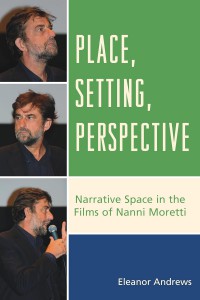
Place, Setting, Perspective
Narrative Space in the Films of Nanni Moretti


 (0 vote)
Average rating:
| 0 | rating |  = We can do without = We can do without |
| 0 | rating |  = Good book = Good book |
| 0 | rating |  = Excellent book = Excellent book |
| 0 | rating |  = Unique / a reference = Unique / a reference |
Your rating: -
Book Presentation:
Place, Setting, Perspective examines the films of the Italian filmmaker, Nanni Moretti, from a fresh viewpoint, employing the increasingly significant research area of space within a filmic text. The book is conceived with the awareness that space cannot be studied only in aesthetic or narrative terms: social, political, and cultural aspects of narrated spaces are equally important if a thorough appraisal is to be achieved of an oeuvre such as Moretti’s, which is profoundly associated with socio-political commentary and analysis. After an exploration of various existing frameworks of narrative space in film, the book offers a particular definition of the term based on the notions of Place, Setting, and Perspective. Place relates to the physical aspect of narrative space and specifically involves cityscapes, landscapes, interiors, and exteriors in the real world. Setting concerns genre characteristics of narrative space, notably its differentiated use in melodrama, detective stories, fantasy narratives, and gender based scenarios. Perspective encompasses the point of view taken optically by the camera which supports the standpoint of Moretti’s personal philosophy expressed through the aesthetic aspects which he employs to create narrative space. The study is based on a close textual analysis of Moretti’s eleven major feature films to date, using the formal film language of mise-en-scène, cinematography, editing, and sound. The aim is to show how Moretti selects, organizes, constructs, assembles, and manipulates the many elements of narrative space into an entire work of art, to enable meanings and pleasures for the spectator.
About the Author:
Eleanor Andrews is Senior Lecturer in Italian and Course Leader for Film Studies at the University of Wolverhampton, UK.
Press Reviews:
Nanni Moretti’s films are not as well known in the US as they should be. His is an important body of work that follows in the footsteps of the great Italian neorealists and French New Wave filmmaker Eric Rohmer. Moretti (b. 1953) is much better known and acclaimed in his native Italy and across Europe, but this study by Andrews should bring more American viewers to his work. Andrews’s book, which grew from her dissertation, is only the second on Moretti available in English—after Ewa Mazierska and Laura Rascaroli's The Cinema of Nanni Moretti(CH, Dec'04, 42-2112)—and it does much to advance the scholarship on this director. As the title indicates, Andrews focuses on the significance of spaces in Moretti’s films. . . .Andrews organized her discussion around the different kinds of spaces—interior, exterior, thresholds, domestic, and so on—in the films and the relationships between spaces and themes and characters. Particularly strong are the chapters on Moretti's cinematic narrators as connected to perspective and on Moretti’s use of different settings and their connections to film genre. Summing Up: Recommended. Graduate students, researchers, faculty, professionals. ― Choice Reviews
See the publisher website: Fairleigh Dickinson University Press
See the complete filmography of Nanni Moretti on the website: IMDB ...
> From the same author:
Spaces of the Cinematic Home (2017)
Behind the Screen Door
Dir. Eleanor Andrews, Stella Hockenhull and Fran Pheasant-Kelly
Subject: Sociology
> On a related topic:
The Bad Maestro (2026)
Tinto Brass and the Eroticization of (Film) History
Subject: Director > Tinto Brass

Streetwalking on a Ruined Map (1992)
Cultural Theory and the City Films of Elvira Notari
Subject: Director > Elvira Notari
The Cinema of Nanni Moretti (2004)
Dreams and Diaries
by Ewa Mazierska and Laura Rascaroli
Subject: Director > Nanni Moretti
Django and the Others (2024)
Many Stories, One Life
by Franco Nero and Lorenzo De Luca
Subject: Actor > Franco Nero
 Back
Back

