

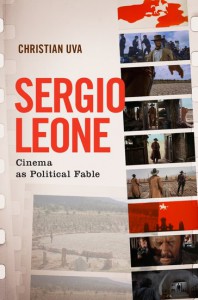
Sergio Leone
Cinema as Political Fable


 (0 vote)
Average rating:
| 0 | rating |  = We can do without = We can do without |
| 0 | rating |  = Good book = Good book |
| 0 | rating |  = Excellent book = Excellent book |
| 0 | rating |  = Unique / a reference = Unique / a reference |
Your rating: -
Book Presentation:
• Offers a sophisticated portrait of Sergio Leone's professional and intellectual evolution
• Synthesizes existing scholarship on Leone with modern and postmodern critical theory
• Lends itself to a variety of uses - as biography, philosophical text, and film analysis
Spectacle, myth, fable - these words instantly leap to mind when considering director Sergio Leone's celebrated films. His popularization of the Spaghetti Western genre, through works like A Fistful of Dollars (1964) and Once Upon a Time in the West (1968), continues to have a profound impact on filmmakers worldwide. In this exciting new study, Italian film scholar Christian Uva explores a side of Leone's works rarely before discussed: the political. Grappling with the contradictions between Leone's politically critical cinematic eye and his aversion to ideological classification, Sergio Leone: Cinema as Political Fable makes sense of how the director's internal political tensions shaped the radical themes of his Western fables.
Looking at Leone and his films through a number of lenses, the book examines the elements of Italian history and identity interwoven in the director's stories, provides cultural context for a career spanning from Italy's fascist regime to Leone's death in 1989, and discusses the influences that formed Leone's directorial identity. Uva focuses in particular on the postmodernist theory behind Leone's works, revealing the critical basis of his stylistic and narrative innovations and newly analyzing the most iconic sequences from The Good, the Bad, and the Ugly (1967), Duck, You Sucker (1971), and Once Upon a Time in America (1984). An admirably thorough take on the man and his works, Sergio Leone: Cinema as Political Fable provides fresh perspective on a director long-established in cinema canon.
About the Author:
Christian Uva, Professor of Film, University of Rome Christian Uva is Associate Professor of Cinema, Photography and Television at Roma Tre University. He has published at length on the relationship between Italian cinema, history, and politics, and on the image in the age of digital production. Among his publications are Schermi di piombo. Il terrorismo nel cinema italiano (2007), Cinema digitale (2012), L'immagine politica (2015), and Il sistema Pixar (2017).
See the publisher website: Oxford University Press
See the complete filmography of Sergio Leone on the website: IMDB ...
> Books with the same or similar title:
> From the same author:
Italian Political Cinema (2016)
Public Life, Imaginary, and Identity in Contemporary Italian Film
Dir. Giancarlo Lombardi and Christian Uva
> On a related topic:
The Bad Maestro (2026)
Tinto Brass and the Eroticization of (Film) History
Subject: Director > Tinto Brass
Place, Setting, Perspective (2016)
Narrative Space in the Films of Nanni Moretti
Subject: Director > Nanni Moretti
Streetwalking on a Ruined Map (1992)
Cultural Theory and the City Films of Elvira Notari
Subject: Director > Elvira Notari
 Back
Back

