


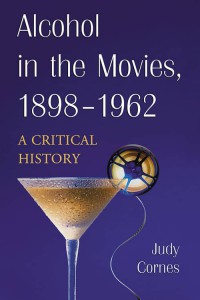
Alcohol in the Movies, 1898–1962
A Critical History
by Judy Cornes


 (0 vote)
Average rating:
| 0 | rating |  = We can do without = We can do without |
| 0 | rating |  = Good book = Good book |
| 0 | rating |  = Excellent book = Excellent book |
| 0 | rating |  = Unique / a reference = Unique / a reference |
Your rating: -
Book Presentation:
A 1906 film called The Dream of a Rarebit Fiend shows a man drinking and eating voraciously at a restaurant, then going home to bed. In the surreal scenes that follow, furniture disappears, tiny devils poke the man’s head with pitchforks, and his bed hurls itself out the window and across the city. But it wasn’t commentary on drinking; rather, it was a showcase of early special effects—double exposure photography, panning shots, and montage. Turn-of-the-century films typically treated drinking as a subject for comedy and ridicule, and the comic possibilities translated well into silent movies. As talkies developed and the film industry matured, alcohol’s portrayal was reflected in the times: prohibition, the Great Depression, the war years, and as social commentary.
Here is a study of 64 years of alcohol as portrayed in film. The author begins with the appearance in 1898 of what is probably the first commercial: a 30-second film of men in kilts dancing and the words “Scotch Whiskey” appearing in the background. The final film is 1962’s Days of Wine and Roses, which addresses alcoholism. The author includes a film from each decade, those with artistic or historical value, those that represent the comedy, drama and musical genres, and well-known pictures such as The Lost Weekend and A Star Is Born. The first three chapters cover 1903 to 1939. The remaining chapters follow not a timeline but the growing complexity of the movies. A recurring motif is the use of the term “white logic,” a phrase used by writer Jack London in his 1913 memoir John Barleycorn. It refers to disillusionment with everyday life brought on by and exacerbated by alcohol. An annotated filmography lists the date, source and other relevant information about movies in this study.
About the Author:
Judy Cornes is a retired English professor from Odessa College in Texas. She lives in Kansas City, Missouri.
Press Reviews:
"thoroughly readable – and a major resource on the subject"—The Slide Area.
> On a related topic:
Feminist Visions (2026)
Tracing Feminist Epistemologies in Contemporary Film and Television
Dir. Hélène Charlery and Cristelle Maury
Subject: Sociology
Unsuitable Film and Video Audiences (2026)
Underage Viewing Memories and Practices in 1980s United Kingdom
by Peter Turner
Subject: Sociology
Displacement of (M)others in Twenty-First-Century US Films (2026)
Impact on Maternal Identities of "Other" Subjectivities
Subject: Sociology
Images of Unrest (2026)
Documentary Film and Political Violence
by Nikolaj Lübecker and Daniele Rugo
Subject: Sociology

Kinotopias (2026)
Film, Place and Belonging in a Bordered World
by Kevin Smets, Lennart Soberon, Irene Gutiérrez-Torres and Silvia Almenara-Niebla
Subject: Sociology

River Delta Futures (2026)
Endangered Communities in Audiovisual Media
Dir. Francisco-J. Hernández Adrián and Angelos Theocharis
Subject: Sociology
 Back
Back

