


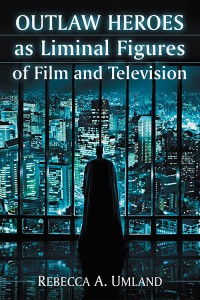
Outlaw Heroes as Liminal Figures of Film and Television


 (0 vote)
Moyenne des votes :
| 0 | vote |  = On peut s'en passer = On peut s'en passer |
| 0 | vote |  = Bon livre = Bon livre |
| 0 | vote |  = Excellent livre = Excellent livre |
| 0 | vote |  = Unique / une référence = Unique / une référence |
Votre vote : -
Description de l'ouvrage:
Unlike such romanticized renegades as Robin Hood and Jesse James, there is another kind of outlaw hero, one who lives between the law and his own personal code. In times of crisis, when the law proves inadequate, the liminal outlaw negotiates between the social imperatives of the community and his innate sense of right and wrong. While society requires his services, he necessarily remains apart from it in self-preservation. The modern outlaw hero of film and television is rooted in the knight errant, whose violent exploits are tempered by his solitude and devotion to a higher ideal. In Hollywood classics such as Casablanca (1942) and Shane (1953), and in early series like The Lone Ranger (1949–1957) and Have Gun—Will Travel (1957–1963), the outlaw hero reconciles for audiences the conflicting impulses of individual freedom versus serving a larger cause. Urban westerns like the Dirty Harry and Death Wish franchises, as well as iconic action figures like Rambo and Batman, testify to his enduring popularity. This book examines the liminal hero’s origins in medieval romance, his survival in the mythology of the Hollywood western and his incarnations in the urban western and modern action film.
À propos de l'auteur :
Rebecca A. Umland is a professor of English at the University of Nebraska at Kearney. She has coauthored two books: The Use of Arthurian Legend in Hollywood Film and Donald Cammell: A Life on the Wild Side, and has published book chapters and articles on Arthurian legend, world cinema, and British literature.
Revue de Presse:
"A compelling and insightful study…strongly recommended"—Mythlore
"Well written and gives very good introductions to the production histories, topics, and plots of the examined narrations"—Helden
> Sur un thème proche :
Feminist Visions (2026)
Tracing Feminist Epistemologies in Contemporary Film and Television
Dir. Hélène Charlery et Cristelle Maury
Sujet : Sociology
Unsuitable Film and Video Audiences (2026)
Underage Viewing Memories and Practices in 1980s United Kingdom
de Peter Turner
Sujet : Sociology
Displacement of (M)others in Twenty-First-Century US Films (2026)
Impact on Maternal Identities of "Other" Subjectivities
Sujet : Sociology
Images of Unrest (2026)
Documentary Film and Political Violence
de Nikolaj Lübecker et Daniele Rugo
Sujet : Sociology

Kinotopias (2026)
Film, Place and Belonging in a Bordered World
de Kevin Smets, Lennart Soberon, Irene Gutiérrez-Torres et Silvia Almenara-Niebla
Sujet : Sociology

River Delta Futures (2026)
Endangered Communities in Audiovisual Media
Dir. Francisco-J. Hernández Adrián et Angelos Theocharis
Sujet : Sociology
 Retour