


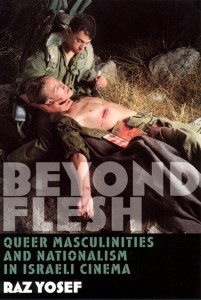
Beyond flesh
queer masculinities and nationalism in Israeli cinema
by Raz Yosef


 (0 vote)
Average rating:
| 0 | rating |  = We can do without = We can do without |
| 0 | rating |  = Good book = Good book |
| 0 | rating |  = Excellent book = Excellent book |
| 0 | rating |  = Unique / a reference = Unique / a reference |
Your rating: -
Book Presentation:
Zionism was not only a political and ideological program but also a sexual one. The liberation of Jews and creation of a new nation were closely intertwined with a longing for the redemption and normalization of the Jewish male body. That body had to be rescued from anti-Semitic, scientific-medical discourse associating it with disease, madness, degeneracy, sexual perversity, and femininityeven with homosexuality. The Zionist movement was intent on transforming the very nature of European Jewish masculinity as it had existed in the diaspora. Zionist/Israeli films expressed this desire through visual and narrative tropes, enforcing the image of the hypermasculine, colonialist-explorer and militaristic nation-builder, an image dependent on the homophobic repudiation of the "feminine" within men.
The creation of a new heterosexual Jewish man was further intertwined with attitudes on the breeding of children, bodily hygiene, racial improvement, and Orientalist perspectiveswhich associated the East, and especially Eastern bodies, with unsanitary practices, plagues, disease, and sexual perversity. By stigmatizing Israels Eastern populations as agents of death and degeneration, Zionism created internal biologized enemies, against whom the Zionist society had to defend itself. In the name of securing the life and reproduction of the new Ashkenazi Jewry, Israeli society discriminated against both its internal enemies, the Palestinians, and its own citizens, the Mizrahim (Oriental Jews).
Yosefs critique of the construction of masculinities and queerness in Israeli cinema and culture also serves as a model for the investigation of the role of male sexuality within national culture in general.
> From the same author:

> On a related topic:

New Directions in Israeli Media (2025)
Film, Television, and Digital Content
Dir. Yaron Peleg, Eran Kaplan and Ido Rosen




Casting a Giant Shadow (2021)
The Transnational Shaping of Israeli Cinema
Dir. Lucy Fischer and Dan Chyutin


From Us to Me (2019)
The Israeli Cinema between Nationalism and Individualism, 1964–1994
by Dror Izhar

Warriors, Witches, Whores (2017)
Women in Israeli Cinema


Reel Gender (2024)
Palestinian and Israeli Cinema
Dir. Sa'ed Atshan and Katharina Galor
Subject: Countries > Middle East
 Back
Back