


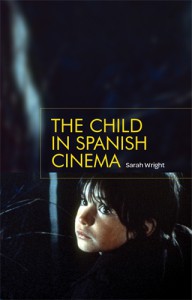
The Child in Spanish Cinema
de Sarah Wright


 (0 vote)
Moyenne des votes :
| 0 | vote |  = On peut s'en passer = On peut s'en passer |
| 0 | vote |  = Bon livre = Bon livre |
| 0 | vote |  = Excellent livre = Excellent livre |
| 0 | vote |  = Unique / une référence = Unique / une référence |
Votre vote : -
Description de l'ouvrage:
In this, the first full-length treatment of the child in Spanish cinema, Sarah Wright explores the ways that the cinematic child comes to represent 'prosthetic memory'. The central theme of the child and the monster is used to examine the relationship of the self to the past, and to cinema.
Concentrating on films from the 1950s to the present day, the book explores religious films, musicals, 'art-house horror', science-fiction, social realism and fantasy. It includes reference to Erice's The Spirit of The Beehive, del Toro's Pan's Labyrinth, Mañas's El Bola and the Marisol films. The book also draws on a century of filmmaking in Spain and intersects with recent revelations concerning the horrors of the Spanish past. The child is a potent motif for the loss of historical memory and for its recuperation through cinema.
This book is suitable for scholars and undergraduates working in the areas of Spanish cinema, Spanish cultural studies and cinema studies.
À propos de l'auteur :
Sarah Wright is Senior Lecturer in Hispanic Studies at Royal Holloway, University of London
Revue de Presse:
'The study will. be of great value to scholars and students of Spanish culture and film, not only as a survey of the child's presence therein but also as an engaging series of creatively theorized close readings that enrich understanding of films canonical and otherwise.'
Sarah Thomas, Brown University, Modern Language Review Vol 112, Part 1 January 2017
'This book is compelling reading for undergraduate and postgraduate students, film historians, Hispanists in general, and for anyone interested in the imaginary and the construction or invention of children by dictatorial regimes, exploitative producers and politically committed directors. Indeed, it could serve as a mandatory reference text for future university courses on this popular topic.'
Lorraine Ryan, University of Birmingham, Bulletin of Spanish Visual Studies Volume II, Number 1, 2018
Voir le site internet de l'éditeur Manchester University Press
> Du même auteur :
Locating the Voice in Film (2017)
Critical Approaches and Global Practices
Dir. Tom Whittaker et Sarah Wright
Sujet : Theory
> Sur un thème proche :
The Two cines con niño (2018)
Genre and the Child Protagonist in Over Fifty Years of Spanish Film (1955-2010)
Volatile Whiteness (2025)
Race, Cinema, and Europeanization in Spain
Spanish Meta-Art and Contemporary Cinema (2025)
Mirrors to the Unconscious
Catalan Cinema (2024)
The Barcelona Film School and the New Avant-Garde
Dir. Anton Pujol et Jaume Martí-Olivella
Patriarchy's Remains (2024)
An Autopsy of Iberian Cinematic Dark Humour
 Retour

