

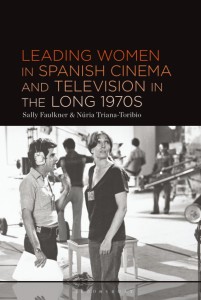
Leading Women in Spanish Cinema and Television in the Long 1970s


 (0 vote)
Average rating:
| 0 | rating |  = We can do without = We can do without |
| 0 | rating |  = Good book = Good book |
| 0 | rating |  = Excellent book = Excellent book |
| 0 | rating |  = Unique / a reference = Unique / a reference |
Your rating: -
Book Presentation:
This open access book offers a feminist cultural history of Spain of the 1970s, exploring the work of women in the audio-visual industries who joined the workforce in significant numbers over this decade of Transition from the Franco dictatorship, to a democracy that enshrined gender equality in its constitution of 1978. Leading Women in Spanish Cinema and Television in the Long 1970s seeks the work of women in new places and analyses it in new ways. Rejecting the director-auteur approach, which has endured for over seventy-five years in both Film and Television Studies - despite the fact that it tends to occlude the work of women - the authors look instead at below-the-line roles in cinema, and at television. In particular, they investigate editing, forgotten or overlooked areas of television broadcasting, such as children’s programming, and film activism in the period, such as in the co-operative Drac Màgic: in these places the work of women can be found. The ebook editions of this book are available open access under a CC BY-NC-ND 4.0 licence on bloomsburycollections.com. Open access was funded by The Arts and Humanities Research Council.
About the Author:
Sally Faulkner is Professor of Spanish at the University of Cambridge, UK, and is a Professorial Fellow of Peterhouse. She has published widely on Spanish film and television, including The Cinema of Cecilia Bartolomé: Feminism and Francoism (2024) and A History of Spanish Film: Cinema and Society 1910-2010 (Bloomsbury Academic, 2013). She currently leads, as Principal Investigator, the research project 'Leading Women in Portuguese and Spanish Cinema and Television,1970-1980', funded by a British government Arts and Humanities Research Council Grant.Nuria Triana-Toribio is Professor of Hispanic Studies at the University of Kent, UK. She is the author of Spanish Film Cultures (2016) and Spanish National Cinema (2003), co-author of The Cinema of Álex de la Iglesia (2007) and co-editor of the series 'Spanish and Latin American Filmmakers'. She is a co-investigator on the AHRC project 'Leading Women in Portuguese and Spanish Cinema and Television, 1970-1980' funded by a British government Arts and Humanities Research Council Grant.
Press Reviews:
"Connecting cinema and television history, bottom-up activism and international cultural transfer, Leading Women in Spanish Cinema and Television in the Long 1970s reframes Spanish transition to democracy as it hasn't been told before. The volume focuses our attention on names and stories usually overseen, on voices rarely heard and on archival sources so far ignored. The result is a thought-provoking and feminist reading of a story we thought we knew so well. Timely and wide-ranging, this book is an important read for anyone interested in Spanish media and cultural history." ―Fernando Ramos, Associate Professor of European Cinema History, Complutense University in Madrid, Spain
"This meticulously researched book presents a fascinating picture of an overlooked element of Spanish cinema of the period; the contribution of women. Drawing on numerous sources, including exhaustive interviews, close analysis and careful presentation of data Faulkner and Triana-Toribio shed light on forgotten, or erased, narratives of the creative contributions that women made to film and television production in the long 1970s in Spain. Significantly, this is a feminist approach that moves away from the primacy of the director-auteur to focus on the below-the-line roles frequently occupied by women. This ambitious book will be a must-read for Hispanists and film and media scholars alike." ―Abigail Loxham, Reader, University of Liverpool, UK
"In this book, Sally Faulkner and Nuria Triana-Toribio read against the grain–with a feminist lens–the history of Spanish cinema and television from the long 1970s. They bring to the fore previously overlooked works, pay much-needed attention to roles 'below-the-line', and mindfully deconstruct auteurist approaches to Spanish film and television, placing leading women at the forefront." ―Sonia García López, Associate Professor, Universidad Carlos III de Madrid, Spain
> From the same author:
A Cinema of Contradiction (2006)
Spanish Film in the 1960s
> On a related topic:
Hispanic and Lusophone Women Filmmakers (2015)
Theory, Practice and Difference
Dir. Parvati Nair and Julian Gutierrez-Albilla
Volatile Whiteness (2025)
Race, Cinema, and Europeanization in Spain
Spanish Meta-Art and Contemporary Cinema (2025)
Mirrors to the Unconscious
Catalan Cinema (2024)
The Barcelona Film School and the New Avant-Garde
Dir. Anton Pujol and Jaume Martí-Olivella
Patriarchy's Remains (2024)
An Autopsy of Iberian Cinematic Dark Humour
 Back
Back