


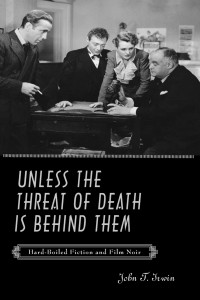
Unless the Threat of Death Is Behind Them
Hard-Boiled Fiction and Film Noir


 (0 vote)
Average rating:
| 0 | rating |  = We can do without = We can do without |
| 0 | rating |  = Good book = Good book |
| 0 | rating |  = Excellent book = Excellent book |
| 0 | rating |  = Unique / a reference = Unique / a reference |
Your rating: -
Book Presentation:
Early in the twentieth century a new character type emerged in the crime novels of American writers such as Dashiell Hammett and Raymond Chandler: the “hard-boiled” detective, most famously exemplified by Sam Spade in The Maltese Falcon. Unlike the analytical detectives of nineteenth-century fiction, such as Edgar Allan Poe’s Inspector Dupin, the new detectives encountered cases not as intricate logical puzzles but as stark challenges of manhood. In the stories of these characters and their criminal opposites, John T. Irwin explores the tension within ideas of American masculinity between subordination and independence and, for the man who becomes “his own boss,” the conflict between professional codes and personal desires. He shows how, within different works of hard-boiled fiction, the professional either overcomes the personal or is overcome by it, ending in ruinous relationships or in solitary integrity, and how within the genre all notions of manly independence are ultimately revealed to be illusions subordinate to fate itself.
Tracing the stylistic development of the genre, Irwin demonstrates the particular influence of the novel of manners, especially the writing of F. Scott Fitzgerald. He goes on to argue that, from the time of World War II, when hard-boiled fiction began to appear on the screen in film noir just as women entered the workforce in large numbers, many of its themes came to extend to female empowerment. Finally, he discusses how these themes persist in contemporary dramatic series on television, representing the conflicted lives of Americans into the twenty-first century.
About the Author:
John T. Irwin is the Decker Professor in the Humanities at the Johns Hopkins University, where he formerly served as chair of the Writing Seminars. His previous books include The Mystery to a Solution: Poe, Borges, and the Analytic Detective Story, recipient of the Modern Language Association’s Scaglione Prize for Comparative Literary Studies and Phi Beta Kappa's Christian Gauss Prize.
Press Reviews:
Irwin succeeds in presenting his topic with the intellectual cachet it deserves.
―Choice
Irwin gracefully and successfully accomplishes the critic's most worthy task―to return us happily to the scene of the crime.
―Patrick O'Donnell, Modernism/Modernity
Stimulating . . . Irwin's psychoanalytic criticism offers subtle readings of the novels, their adaptations, and of the relations between these texts and their authors' lives.
―Brian Diemert, Journal of Popular Culture
Persuasively locates the development of noir out of the quintessentially American genre of hard-boiled detective fiction.
―Thomas Hibbs, Books and Culture
John Irwin is a great original as an American poet-critic. Each new book by him―whether poetry or prose―delights and surprises me, in the mode of a Borgesian essay-fiction or a Kafkan parable, but expanded into the exegetical sublime. Hard-boiled fiction and film noir have found their most illuminating critic in Irwin.
―Harold Bloom
Irwin's analysis of five American crime novels from the Thirties and Forties and his insightful discussion of the 'noir' films based on them cast new light on the qualities of these 'hard-boiled' classics. The surprising affinities he uncovers that link these works with other examples of American 'main-line' fiction will surely increase the reader's perception of the inherent seriousness at the heart of these genre entertainments.
―Donald A. Yates, editor and translator of Latin Blood: The Best Crime Stories from Spanish America
> On a related topic:



I Died a Million Times (2021)
Gangster Noir in Midcentury America
Fatalism in American Film Noir (2013)
Some Cinematic Philosophy


Creatures of Darkness (2000)
Raymond Chandler, Detective Fiction, and Film Noir
Subject: Others persons > Raymond Chandler
 Back
Back