


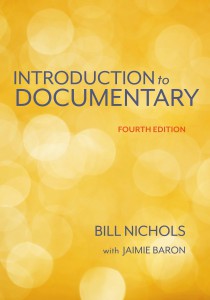
Introduction to Documentary
de Bill Nichols et Jaimie Baron


 (0 vote)
Moyenne des votes :
| 0 | vote |  = On peut s'en passer = On peut s'en passer |
| 0 | vote |  = Bon livre = Bon livre |
| 0 | vote |  = Excellent livre = Excellent livre |
| 0 | vote |  = Unique / une référence = Unique / une référence |
Votre vote : -
Description de l'ouvrage:
The fourth edition of Bill Nichols's best-selling text, Introduction to Documentary, has been vastly altered in its entirety to bring this indispensable textbook up to date and reconceptualize aspects of its treatment of documentaries past and present. Here Nichols, with Jaimie Baron, has edited each chapter for clarity and ease of use and expanded the book with updates and new ideas.
Featuring abundant examples and images, Introduction to Documentary, Fourth Edition is designed to facilitate a rich understanding of how cinema can be used to document the historical world as it is seen by a wide variety of filmmakers. Subjectivity, expressivity, persuasiveness, and credibility are crucial factors that move documentary film away from objective documentation and toward the thought-provoking realm of arguments, perceptions, and perspectives that draw from a filmmaker's unique sensibility to help us see the world as we have not seen it before. Exploring ethics, history, different modes of documentary, key social issues addressed, and both the origins and evolution of this form, this updated volume also offers guidance on how to write about documentaries and how to begin the process of making one.
Introduction to Documentary, Fourth Edition will be of use not only to film students but also those in adjacent fields where visual representations of reality play an important role: journalism, sociology, anthropology, feminist and ethnic studies, among others.
À propos des auteurs :
Bill Nichols is Professor Emeritus of Cinema at San Francisco State University. He is author of Representing Reality: Issues and Concepts in Documentary; Blurred Boundaries: Questions of Meaning in Contemporary Culture; Engaging Cinema: An Introduction to Film Studies; and Speaking Truths with Film: Evidence, Ethics, Politics in Documentary. He is also editor of Movies and Methods, Volumes I and II.Jaimie Baron is Lecturer in Film and Media Studies at the University of California, Berkeley. She is author of The Archive Effect: Found Footage and the Audiovisual Experience of History and Reuse, Misuse, Abuse: The Ethics of Audiovisual Appropriation in the Digital Era as well as many journal articles, book chapters, essays, and reviews. She is founder and director of the Festival of (In)appropriation, a yearly international festival of short experimental found-footage films and videos. She is also a cofounder and coeditor of Docalogue, an online space for scholars and filmmakers to engage in conversations about contemporary documentary, and the Docalogue book series. She is a 2022–23 recipient of a Harvard Radcliffe Fellowship.
Revue de Presse:
"Since its first edition in 2001, Bill Nichols' Introduction to Documentary is the leading textbook on nonfictional cinema. Not exactly a how-to-do guide, a history of documentaries, or an assessment of the specific ethical and aesthetic issues of this production, Nichols's book became an instant classic discussing all of this with clarity and originality for the beginner and the academic, the filmmaker and the viewer. Each part organically updated with new questions and filmic variations, its fourth edition, co-written with Jaimie Baron, offers an even more complex and current approach to the essential book that has been guiding us through the mist of documentary film."
-Amir Labaki, author of Introduction to Brazilian Documentary
"In Introduction to Documentary, Bill Nichols created the first comprehensive taxonomy of documentary film form—one that has given generations of students and scholars a critical language with which they can critically analyze and understand the many complex forms of documentary film. This fourth edition, now joined by scholar Jaimie Baron, uses the latest films from mainstream to the avant-garde to analyze ever-evolving documentary film practices in relation to recent theoretical debates including relationships between fact and fiction, the ethics of representation, point of view, new technologies, and hybrid forms. Written with clarity and generosity, the volume is an essential resource for film and media students, scholars and filmmakers alike."
-Jeffrey Skoller, editor of Postwar: The Films of Daniel Eisenberg
> Des mêmes auteurs :
Summer of Soul (... Or, When the Revolution Could Not Be Televised) (2023)
A Docalogue
Dir. Jaimie Baron et Kristen Fuhs
Sujet : One Film > Summer of Soul
Tiger King (2023)
Murder, Mayhem and Madness: A Docalogue
Dir. Jaimie Baron et Kristen Fuhs
Sujet : One Film > Tiger King (TV Series)
I Am Not Your Negro (2022)
A Docalogue
Dir. Jaimie Baron et Kristen Fuhs
Sujet : One Film > I Am Not Your Negro
Speaking Truths with Film (2016)
Evidence, Ethics, Politics in Documentary
de Bill Nichols
Sujet : Genre > Documentary
Representing Reality (1992)
Issues and Concepts in Documentary
de Bill Nichols
Sujet : Genre > Documentary
> Sur un thème proche :

André Bazin on Documentary (2026)
Cinema's Urge to Explore
Dir. André Bazin
Sujet : Genre > Documentary
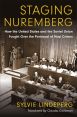
Staging Nuremberg (2026)
How the United States and the Soviet Union Fought Over the Portrayal of Nazi Crimes
Sujet : Genre > Documentary
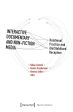
Interactive Documentary and Non-Fiction Media (2026)
Relational Practice and (De)Stabilized Reception
Dir. Tobias Conradi, Florian Krautkrämer et Vanessa Zallot
Sujet : Genre > Documentary

The Heroic Age of Antarctic Exploration on Film and Television, Volume 1 (2025)
Ernest Shackleton
de John Atkins
Sujet : Genre > Documentary
The Heroic Age of Antarctic Exploration on Film and Television, Volume 2 (2025)
Scott and Amundsen
de John Atkins
Sujet : Genre > Documentary
 Retour

