


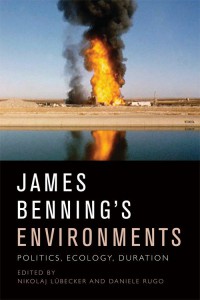
James Benning's Environments
Politics, Ecology, Duration
Edited by Nikolaj Lübecker and Daniele Rugo


 (0 vote)
Average rating:
| 0 | rating |  = We can do without = We can do without |
| 0 | rating |  = Good book = Good book |
| 0 | rating |  = Excellent book = Excellent book |
| 0 | rating |  = Unique / a reference = Unique / a reference |
Your rating: -
Book Presentation:
Explores James Benning’s films through their material environments and the perceptual environments his works create
For more than forty years, the experimental filmmaker James Benning has been engaged in a systematic investigation of the relations between man, landscape, and the filmic medium, and during the last decade it has become increasingly clear how much these investigations have to offer to contemporary debates about ecology, the age of the anthropocene and the potentialities of new digital technologies. In James Benning’s Environments a range of international scholars highlight the thematic and formal coherence of Benning’s practice, whilst providing readers with an artistic and historical context to understand his experimental film work. The volume offers a number of interpretative frameworks drawing on film theory, environmental humanities, visual culture and philosophy, explaining why Benning has emerged as one of today’s essential filmmakers.
Key Features
• Contextualises Benning’s work in relation to the most important artistic and socio-historical influences on his filmmaking
• Analyses Benning as an eco-filmmaker with perspectives from environmental studies and eco-cinema
• Offers philosophical approaches to Benning’s films in view of their aesthetic, political and epistemological import
About the authors:
Nikolaj Lübecker is Professor of French and Film Studies at St John’s College, University of Oxford. His publications focus on contemporary American and European cinema, French literature and critical theory. His most recent book, The Feel-Bad Film (Edinburgh UP, 2015), investigates logics of unpleasure in films by directors such as Claire Denis, Lars von Trier, Gus Van Sant, Bruno Dumont and Harmony Korine.
Daniele Rugo is Professor in the Department of Arts & Humanities at Brunel University London. He is the author of two books, Philosophy and the Patience of Film (Palgrave, 2016) and Jean-Luc Nancy and the Thinking of Otherness (Bloomsbury, 2013), and his articles have appeared in various journals including Angelaki, Third Text, Cultural Politics and Film-Philosophy. He is the recipient of an Arts and Humanities Research Council Innovation Grant for the project 'Following the Wires', which uses film to examine post-conflict scenarios in Lebanon.
See the publisher website: Edinburgh University Press
See the complete filmography of James Benning on the website: IMDB ...
> From the same authors:
Images of Unrest (2026)
Documentary Film and Political Violence
by Nikolaj Lübecker and Daniele Rugo
Subject: Sociology


> On a related topic:
Slow Places in Béla Tarr's Films (2023)
The Intersection of Geography, Ecology, and Slow Cinema
by Clara Orban
River Delta Futures (2026)
Endangered Communities in Audiovisual Media
Dir. Francisco-J. Hernández Adrián and Angelos Theocharis
Subject: Sociology


Ecological And Environmental Turns (2025)
(Re)mapping China's Sociocultural Landscape through Ecocinema
by Shuqin Cui
 Back
Back

