


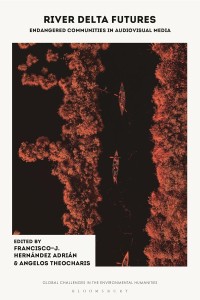
River Delta Futures
Endangered Communities in Audiovisual Media
Edited by Francisco-J. Hernández Adrián and Angelos Theocharis


 (0 vote)
Average rating:
| 0 | rating |  = We can do without = We can do without |
| 0 | rating |  = Good book = Good book |
| 0 | rating |  = Excellent book = Excellent book |
| 0 | rating |  = Unique / a reference = Unique / a reference |
Your rating: -
Book Presentation:
How are climate change, weather-related disasters, food and water insecurity, and energetic and infrastructural collapse narrated audiovisually in the most environmentally vulnerable areas of the Planet? This book addresses this and related questions by adopting a local and transdisciplinary perspective on river deltas from different areas of the world. River deltas have historically been hotspots for human civilizations, as populations settled in their fertile grounds seeking resources and opportunities for prosperity. Despite this, the terrains and livelihoods of those who rely on them are under threat from human exploitation, environmental degradation, and rapidly accelerating climate change. Inspired by the UN Sustainable Development Goals, this book provides a range of focused audiovisual analyses of deltaic spaces. Ranging across a variety of media, including documentary filmmaking, animation, photography, collaborative comic making, participatory visual art practices, soundwalking, and film analysis, it examines the role that contemporary audiovisual media play in forging global environmental imaginaries. In doing so, it adopts a transdisciplinary approach to the Blue Humanities from countries across the world, including Canada, Bolivia, Brazil, Greece, Nigeria, Senegal, India, Bangladesh, Myanmar, Thailand, and Vietnam.
About the authors:
Steven Hartman is Visiting Professor of English at Mälardalen University in Sweden and Associate Scientist at Stefansson Arctic Institute in Iceland. His work focuses on environmental memory in literature; integrating the humanities in global change research and policy; and building collaborations among artists, researchers, educators and civil society to help mobilize public action on climate change. In 2020 he is co-leading efforts to launch BRIDGES, a humanities-centered global coalition for sustainability science, in close cooperation with UNESCO and the International Council for Philosophy and Human Sciences (CIPSH). He also directs the Humanities for the Environment Circumpolar Observatory anchored at the Stefansson Arctic Institute in Iceland and for over a decade he led the Nordic Network for Interdisciplinary Environmental Studies (NIES). Together with Dr. Astrid Ogilvie, he co-leads the international research project Reflections of Change: The Natural World in Literary and Historical Sources from Iceland ca. AD 800 to 1800 (ICECHANGE) funded by Riksbankens Jubileumsfond (2017-2020). An article from this project, “Medieval Iceland, Greenland and the New Human Condition: a case study in integrated environmental humanities,” for which he was lead author, won the biennial St. Andrews Article Prize in European Environmental History in 2019. Hartman's publications have appeared in a wide range of scholarly, scientific and literary journals, including PMLA, Global and Planetary Change, ISLE: Interdisciplinary Studies in Literature and Environment, Ecozon@, the New York Review of Books Online, The Holocene, Agni Online, the Southern Review, Witness and the Georgia Review, as well as in anthologies from academic publishers such as Cambridge UP, Routledge, Wiley-Blackwell and Brill.Angelos Theocharis is Leverhulme Early Career Fellow in Media, Culture and Heritage at theSchool of Arts and Cultures, Newcastle University, UKParker Krieg is a postdoctoral fellow in environmental humanities at the University of Helsinki, Finland, affiliated with the Humanities program in the Faculty of Arts and the Helsinki Institute of Sustainability Science. His dissertation, Nature Industries: U.S. Environmental Fictions after Fordism, 1971-2011, examines the transformation of environmental narratives in the political and cultural economy of post-Fordism. His recent publications include “Energy Futures: John Updike's Petrofictions,” in Studies in American Fiction; “Planetary Delta: Anthropocene Lives in the Blues Memoir,” in A/B: Auto/Biography Studies; “Carnival Anthropocene: Myth and Cultural Memory in Monique Roffey's Archipelago,” in Ecozon@: European Journal of Literature, Culture, and Environment. Book chapters in forthcoming collections are currently with Bloomsbury, Routledge, and West Virginia University Press. As a member of the Humanities for the Environment (HfE) Circumpolar Observatory, he co-edits a special issue of the journal Humanities on Food Culture and Critical Sustainability. Other associations include Modern Language Association, Association for the Study of Literature and Environment, Cultural Studies Association, and the European Association of American Studies. His co-edited collection, Situating Sustainability: A Handbook of Contexts and Concepts, is currently under review with Helsinki University Press.
> On a related topic:

Totally Radical (2026)
Teenage Mutant Ninja Turtles and Environmental Justice
by Ian Boucher
Subject: Sociology
Nuclear Futures in the Post-Fukushima Age (2024)
Literature, Film, and Performance from Germany and Japan
Dir. Hester Baer and Michele M. Mason
Subject: Sociology


Thanatourism and Cinematic Representations of Risk (2019)
Screening the End of Tourism
Subject: Genre > Disaster films
Feminist Visions (2026)
Tracing Feminist Epistemologies in Contemporary Film and Television
Dir. Hélène Charlery and Cristelle Maury
Subject: Sociology

Unsuitable Film and Video Audiences (2026)
Underage Viewing Memories and Practices in 1980s United Kingdom
by Peter Turner
Subject: Sociology
Displacement of (M)others in Twenty-First-Century US Films (2026)
Impact on Maternal Identities of "Other" Subjectivities
Subject: Sociology
Images of Unrest (2026)
Documentary Film and Political Violence
by Nikolaj Lübecker and Daniele Rugo
Subject: Sociology
 Back
Back

