


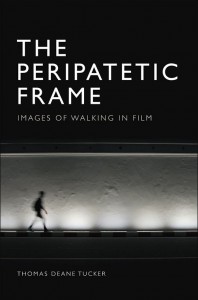
The Peripatetic Frame
Images of Walking in Film


 (0 vote)
Average rating:
| 0 | rating |  = We can do without = We can do without |
| 0 | rating |  = Good book = Good book |
| 0 | rating |  = Excellent book = Excellent book |
| 0 | rating |  = Unique / a reference = Unique / a reference |
Your rating: -
Book Presentation:
The first philosophical exploration of the act of walking as it is represented in film
• Breaks new ground in motion studies as it relates to film
• Helps readers gain a fresh insight into film history through another perspective
• Covers star walks, walking in genre films, urban walking, walking in nature and the idea of the camera as a pedestrian
From cinema’s earliest days, walking and filmmaking have been intrinsically linked. Technologically, culturally and aesthetically, the pioneers of cinema were not only interested in using the camera to scientifically study ambulatory motion, but were also keen to capture the speed and mobile culture of late 19th-century urban life.
Photographers such as Felix Nadar took their cameras into the Parisian streets and boulevards as mechanised flâneurs, ushering us into the age of the ‘mobilised virtual gaze’. But if photography could only embalm modernity in an instant of time, the cinema brought these instants to life again.
From Muybridge and Marey’s photographic studies of motion to Charlie Chaplin’s character ‘The Tramp’, and from the Steadicam to the police procedural, Thomas Deane Tucker explores the intertwined relationship between cinema and walking from its very first steps – breaking new ground in motion studies and providing a bold new perspective on film history.
About the Author:
Thomas Deane Tucker is Professor of Humanities at Chadron State College. He is the author of Derridada: Duchamp as Readymade Deconstruction (Lexington Books, 2008) and co-editor of Terrence Malick: Film and Philosophy (Continuum, 2011).
Press Reviews:
Thomas Deane Tucker's The Peripatetic Frame offers an erudite historical and theoretical exploration of the fascinating affinities between walking and cinema. Tracking the parallels between cinematic and perambulatory movement in all their philosophical variants, Tucker takes the reader on an invigorating theoretical expedition spanning Chaplin’s walk, the camera as pedestrian, to journeying home and cinematic flânerie.– Prof Robert Sinnerbrink, Macquarie University
> On a related topic:
Contemporary Screen Ethics (2025)
Absences, Identities, Belonging, Looking Anew
Dir. Lucy Bolton, David Martin-Jones and Robert Sinnerbrink
Subject: Theory
Cinecepts, Deleuze, and Godard-Miéville (2025)
Developing Philosophy through Audiovisual Media
Subject: Theory
Cinema of/for the Anthropocene (2025)
Affect, Ecology, and More-Than-Human Kinship
Dir. Katarzyna Paszkiewicz and Andrea Ruthven
Subject: Theory
 Back
Back

