


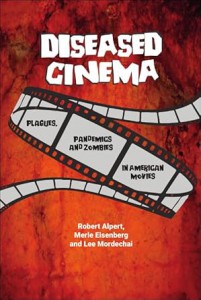
Diseased Cinema
Plagues, Pandemics and Zombies in American Movies
by Robert Alpert, Merle Eisenberg and Lee Mordechai


 (0 vote)
Average rating:
| 0 | rating |  = We can do without = We can do without |
| 0 | rating |  = Good book = Good book |
| 0 | rating |  = Excellent book = Excellent book |
| 0 | rating |  = Unique / a reference = Unique / a reference |
Your rating: -
Book Presentation:
American movies about infectious diseases have reflected and driven dominant cultural narratives during the past century. These movies – both real pandemics and imagined zombie outbreaks – have become wildly popular since the beginning of the 21st century.
They have shifted from featuring a contained outbreak to an imagined containment of a known disease to a globalized, uncontainable pandemic of an unknown origin. Movie narratives have changed from identifying and solving social problems to a despair and acceptance of America’s failure to fulfil its historic social contract.
Movies reflect and drive developments in American capitalism that increasingly advocates for individuals and their families, rather than communities and the public good. Disease movies today minimize human differences and envisage a utopian new world order to advance the needs of contemporary American capitalism. These movie narratives shaped reactions to the outbreak of Covid and reinforced individual responsibility as the solution to end the pandemic.
About the authors:
Robert Alpert is an Adjunct Instructor at Fordham University where he has taught courses on computers and robots in film, movies and the American experience, and media law. He haswritten extensively on movies, including on directors, such as Chaplin, Meyers, and Bigelow, as well as on other topics, such as gender, the Hollywood idiom, and the politics of science fiction. His publications can be found in Jump Cut, Senses of Cinema, and CineAction. Alpert received his M.F.A. in Film from Columbia University. He also received a J.D. from New York University and practiced intellectual property law for over 30 years.Merle Eisenberg is an Assistant Professor of History at Oklahoma State University and a founding faculty member of the Oklahoma State Pandemic Center. He has published articles in journals including The American Historical Review and Past & Present. His work has also appeared in The Proceedings of the National Academy of Sciences, which received press coverage in CNN, Fox News, USA Today, and the NY Post. He has also appeared on CNN to discuss historical pandemics and regularly teaches courses on plagues and pandemics in history. Along with Lee Mordechai, he is the co-founder and co-host of the Infectious Historians podcastLee Mordechai is a Senior Lecturer at the Hebrew University of Jerusalem and the Associate Director of Princeton University’s Climate Change and History Research Initiative. He has published over twenty academic articles, including two in the Proceedings of the National Academy of Sciences, and two in the leading history journals, The American Historical Review and Past & Present. He has taught several courses on epidemics, including a seminar that uses the current draft of the proposed book. Along with Merle Eisenberg, he is the co-founder and co-host of the Infectious Historians podcast.
Press Reviews:
The book delivers a fresh look at the ever-growing number of American pandemic movies and their apocalyptic and post-apocalyptic mythology.
-- Christos Lynteris, University of St Andrews
Diseased Cinema tracks the cinematic fascination with disease throughout the history of film, showing how depictions of communicable disease mutate to reflect changing social and political concerns and how they, in turn, shape expectations about and the experience of actual disease outbreaks. An important work that reveals the power of cinema and the figure of disease to shape a cultural imagination.
-- Priscilla Wald, Duke University
> On a related topic:

Ghouls, Gimmicks, and Gold (2004)
Horror Films and the American Movie Business, 1953-1968
Ad Nauseam (2026)
Newsprint Nightmares from the '70s and '80s
Horror House Film (2026)
Possession, Obsession, Domination, Masculinity

 Back
Back

