

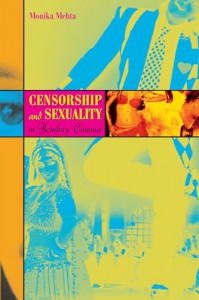
Censorship and Sexuality in Bombay Cinema
by Monika Mehta


 (0 vote)
Average rating:
| 0 | rating |  = We can do without = We can do without |
| 0 | rating |  = Good book = Good book |
| 0 | rating |  = Excellent book = Excellent book |
| 0 | rating |  = Unique / a reference = Unique / a reference |
Your rating: -
Book Presentation:
India produces an impressive number of films each year in a variety of languages. Here, Monika Mehta breaks new ground by analyzing Hindi films and exploring the censorship of gender and heterosexuality in Bombay cinema. She studies how film censorship on various levels makes the female body and female sexuality pivotal in constructing national identity, not just through the films themselves but also through the heated debates that occur in newspapers and other periodicals. The standard claim is that the state dictates censorship and various prohibitions, but Mehta explores how relationships among the state, the film industry, and the public illuminate censorship's role in identity formation, while also examining how desire, profits, and corruption are generated through the act of censoring.
Committed to extending a feminist critique of mass culture in the global south, Mehta situates the story of censorship in a broad social context and traces the intriguing ways in which the heated debates on sexuality in Bombay cinema actually produce the very forms of sexuality they claim to regulate. She imagines afresh the theoretical field of censorship by combining textual analysis, archival research, and qualitative fieldwork. Her analysis reveals how central concepts of film studies, such as stardom, spectacle, genre, and sound, are employed and (re)configured within the ambit of state censorship, thereby expanding the scope of their application and impact.
> From the same author:
Industrial Networks and Cinemas of India (2020)
Shooting Stars, Shifting Geographies and Multiplying Media
Dir. Monika Mehta and Madhuja Mukherjee
Pop Empires (2019)
Transnational and Diasporic Flows of India and Korea
Dir. S. Heijin Lee, Monika Mehta and Robert Ji-Song Ku
> On a related topic:
Muslim Identity in Hindi Cinema (2025)
Poetics and Politics of Genre and Representation
Cinema and the Indian National Emergency (2025)
Histories and Afterlives
Dir. Parichay Patra and Dibyakusum Ray
A History of India's North-East Cinema (2025)
Deconstructing the Stereotypes
The Revolution of Indian Parallel Cinema in the Global South (1968–1995) (2025)
From Feminism to Iconoclasm
by Omar Ahmed
 Back
Back