


Bollywood's Corporeal Turn
Aesthetic Response and Diasporic Memory
by Vijay Mishra and Sudesh Mishra

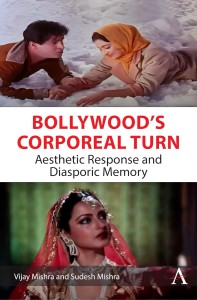

 (0 vote)
Average rating:
| 0 | rating |  = We can do without = We can do without |
| 0 | rating |  = Good book = Good book |
| 0 | rating |  = Excellent book = Excellent book |
| 0 | rating |  = Unique / a reference = Unique / a reference |
Your rating: -
Book Presentation:
Explores Bollywood cinema’s aesthetic, cultural and corporeal dimensions across foundational genres, iconic performers and diasporic narratives, highlighting the interplay of narrative, poetry, the body and national and transnational identities.
The first substantive chapter of the book recovers the special allure of Parsi theatre and the role of the Muslim courtesan in Bollywood cinema. If the first provided a foundational cinematic scaffolding, the Muslim courtesan films gave the cinema its very special quality, more immediately the language of poetry in Urdu. There was nevertheless a tragic quality to the Muslim courtesan films and that tragic quality was given structural form through the ‘Devdas’ movies of the sentimental man of feeling whose life is marked by loss, failure to find the object of love and finally sacrifice in death.
Beginning with Chapter Two the book offers three genres that are foundational to any serious reading of Bollywood cinema. The first, dealt with in Chapter Two, is the genre of the Arabian Nights tales in as much as these fantasies provided a narrative base that emphasised India’s own inter-connected and diverse cultural heritage. The second, Bollywood mythologicals, examined in Chapter Three express what may be called the religio-cultural dominant of the nation. The third, examined in Chapter Four, is the disturbing fantasy of the darker, Gothic, side of humanity. However, when it came to the latter’s transformation in the established melodramatic genre of Bollywood, the Gothic took the form of reincarnation tales.
The book is defined by the correspondence between cinema and one’s passionate, sensual and even libidinal relationship to it. The corporeal aesthetic is read through two exemplary actors: Helen and Shammi Kapoor. They occupy Chapters Five and Six of the book, and both chapters have as their central theme precisely the question of the body in cinema and its articulation or representation either as an allegory of lived experience or as a redefinition of affective or precognitive understanding of the nation. Against the earlier emphasis on doctrinaire ethics, allegorical masculinity and nationalist ideology via a socialist realism, the libidinal enjoyment of the spectatorial image led to sensual delight and an understanding of the hitherto undertheorized aesthetic possibilities of the body in cinema.
The final substantive chapter (Chapter Seven) examines a dramatic turn during the first ten years of the third millennium. The book frames this shift with reference to elements of the diasporic imaginary captured in some of the films of the period and foreshadowed in the Prologue. In these films, Bollywood cinema unobtrusively enters the life-worlds of the burgeoning Indian diaspora and brings it into its own socio-political sphere. It is also a cinema where, beyond the confines of the Indian nation, the diaspora looks back at the homeland as a space of redemption as well as creativity but without uncritically embracing the jingoism and propagandist historical distortions that have in recent years confounded socio-political norms and bedevilled the nation via films like The Kashmir Files (2022), Chhaava (2025) and Dhurandhar (2025).
About the authors:
Vijay Mishra is an Emeritus Professor of English and Comparative Literature and Professorial Fellow of the Indo-Pacific Centre at Murdoch University, Perth, Australia.Sudesh Mishra is Professor of Literature at the University of the South Pacific, Suva, Fiji.
Press Reviews:
"Memories, yearnings, longings, and dreams of the plantation diaspora intersect with global cultural traffic in this superb reading of Bollywood’s past, present, and future travels. Stories, music, language, and bodies swirl through this evocative tale of corporeal aesthetics in a world of blurred borders." ―Ranjani Mazumdar, Professor of Cinema Studies, Jawaharlal Nehru University, India
"A compelling account of how Bollywood’s aesthetic possibilities shaped and sustained the Indian plantation diasporas’ relationship with their ancestral homeland. Theoretically rigorous and rich in archival research, this book presents an insightful and textured analysis of how memory, space, and nostalgia influence Bollywood’s reception beyond the boundaries of the nation."―Nandi Bhatia, PhD, Professor, English and Writing Studies, Faculty of Arts and Humanities, University of Western Ontario London, Canada
"This wide-ranging, deeply researched, and exquisitely written work radically expands the meanings and pleasures of Bollywood from the vantage of the labourers and their descendants in a former-plantation economy of the Global South and in so doing, provides a roadmap for decolonizing film studies." ―Sangita Gopal, Professor of Cinema Studies at University of Oregon, USA
"Mixing the corporeal and the affective and taking us on a journey through the Kaala Paani/Black Sea with migration stories and pleasures found only in Bollywood cinema, this book offers us an exciting and new reading of the global and popular film form."―Professor Rajinder Dudrah, Birmingham City University, UK
"Bollywood’s Corporeal Turn is an evocative and theoretically rich meditation on the affective connections forged through Hindi cinema. In their view from the plantation diaspora, Vijay Mishra and Sudesh Mishra astutely connect cinematic form to histories of displacement, longing, and aesthetic experience, offering an original account of Bollywood’s cultural life." ―Rashmi Sadana, Professor of Anthropology, George Mason University, Author of The Moving City: Scenes from the Delhi Metro and the Social Life of Infrastructure and English Heart, Hindi Heartland: The Political Life of Literature in India
"A must read for a peep into the lifeworlds that the Hindi cinema created for the Indian plantation diaspora. The imagined memory and sense of loss of a ‘homeland’ the second generation never belonged to. A homeland mediatized through the Hindi cinema. Its songs of longing, its genres and their genealogies, and the movie theatres in which its fantasies came alive for young Indian-origin adults. The diaspora changed, as did the cinema. The book is an ode to the lifelong fascination for the bewitching chimera of those worlds, and the characters and bodies that were cast on the screen." ―Dr Rashmi Doraiswamy, retired Professor, Academy of International Studies, Jamia Millia Islamia, India
"Bollywood’s Corporeal Turn: Aesthetic Response and Diasporic Memory stands as a significant contribution to the study of cinema and cultural identity. The book challenges conventional approaches to Bollywood by foregrounding the bodily, emotional, and diasporic dimensions of cinematic experience." ―Aparna Sharma, Professor, Faculty of Social Sciences and Humanities, Bhupal Nobles’ University, India
See the publisher website: Anthem Press
> From the same authors:
> On a related topic:
Muslim Identity in Hindi Cinema (2025)
Poetics and Politics of Genre and Representation
Postcolonial Bollywood and Muslim Identity (2024)
Production, Representation, and Reception


Bollywood and Globalization (2015)
The Global Power of Popular Hindi Cinema
Dir. David J. Schaefer and Kavita Karan
Bollywood and Globalization (2011)
Indian Popular Cinema, Nation, and Diaspora
Dir. Rini Bhattacharya Mehta and Rajeshwari V. Pandharipande

Fingerprinting Popular Culture (2007)
The Mythic and the Iconic in Indian Cinema
by Vinay Lal and Ashis Nandy

Framing the Nation (2011)
Languages of 'Modernity' in India
The Cinematic ImagiNation (2003)
Indian Popular Films as Social History
 Back
Back

