

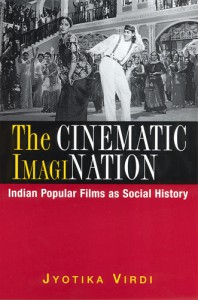
The Cinematic ImagiNation
Indian Popular Films as Social History


 (0 vote)
Average rating:
| 0 | rating |  = We can do without = We can do without |
| 0 | rating |  = Good book = Good book |
| 0 | rating |  = Excellent book = Excellent book |
| 0 | rating |  = Unique / a reference = Unique / a reference |
Your rating: -
Book Presentation:
"This book makes an important contribution to the field of Asian film criticism, Indian film history, cultural studies, and gender studies. The Cinematic ImagiNation provides readers with valuable insight into the relationships between nation-building, gender, sexuality, the family, and popular cinema, using post-Independence India as a case study."
--Gina Marchetti, author of Romance and the "Yellow Peril": Race, Sex, and Discursive Strategies in Hollywood Fiction
India produces more films than any other country in the world, and these works are avidly consumed by non-Western cultures in Africa, Eastern Europe, the Middle East, and by the Indian communities in Australia, Britain, the Caribbean Islands, and North America. Jyotika Virdi focuses on how this dominant medium configures the "nation" in post-Independence Hindi cinema. She scrutinizes approximately thirty films that have appeared since 1950 and demonstrates how concepts of the nation form the center of this cinema's moral universe. As a kind of storytelling, Indian cinema provides a fascinating account of social history and cultural politics, with the family deployed as a symbol of the nation. Virdi demonstrates how the portrayal of the nation as a mythical community in Hindi films collapses under the weight of its own contradictions--irreconcilable differences that encompass gender, sexuality, family, class, and religious communities. Through these film narratives, the author traces transactions among the various constituencies that struggle, accommodate, coexist uneasily, or reconstitute each other over time, and, in the process, reveal the topography of postcolonial culture.
About the Author:
JYOTIKA VIRDI teaches communication/film/media studies at the University of Windsor, Canada.
Press Reviews:
This book makes an important contribution to the field of Asian film criticism, Indian film history, cultural studies, and gender studies. The Cinematic ImagiNation provides readers with valuable insight into the relationships between nation-building gender, sexuality, the family, and popular cinema, using post-Independence India as a case study.
— Gina Marchetti
> On a related topic:
Framing the Nation (2011)
Languages of 'Modernity' in India
Marathi Cinema, Cultural Space, and Liminality (2022)
A History
Partition Literature and Cinema (2020)
A Critical Introduction
Dir. Jaydip Sarkar and Rupayan Mukherjee
Understanding Indian Movies (2008)
Culture, Cognition, and Cinematic Imagination
Gender and Popular Visual Culture in India (2023)
‘Benevolent' Sexism and Disguised Discrimination
Gender, Nation and Popular Film in India (2018)
Globalizing Muscular Nationalism
Muslim Identity in Hindi Cinema (2025)
Poetics and Politics of Genre and Representation

Ways of Remembering (2024)
Law, Cinema and Collective Memory in the New India
 Back
Back