


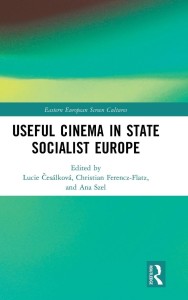
Useful Cinema in State Socialist Europe
Edited by Lucie Česálková, Christian Ferencz-Flatz and Ana Szel


 (0 vote)
Average rating:
| 0 | rating |  = We can do without = We can do without |
| 0 | rating |  = Good book = Good book |
| 0 | rating |  = Excellent book = Excellent book |
| 0 | rating |  = Unique / a reference = Unique / a reference |
Your rating: -
Book Presentation:
Useful Cinema in State Socialist Europe offers a ground-breaking exploration of “useful” film production across Eastern Europe, the Soviet Union, and the wider socialist world from the postwar period to the late Cold War. Moving beyond economically driven models of commissioned filmmaking dominant in the West, it shows how socialist cinema was shaped instead by the ideological power of representation and self-representation, positioning film at the heart of political and cultural governance.
Rejecting any notion of a unified socialist cinema, the chapters reveal a diverse field of practices - educational, instructional, research, safety, promotional, and amateur films - produced within complex institutional and party frameworks. Drawing on internationally significant and topical case studies from both well-known and underexplored national contexts, the book demonstrates how these films simultaneously served centralized political agendas and developed distinct regional and national dynamics. With its interdisciplinary approach and extensive engagement with archival and audiovisual sources, this book makes a major intervention in Film and Media Studies it brings marginal, functional, and non-fiction film forms into the centre of scholarly debate.
A major intervention in Film and Media Studies, this book will appeal to researchers in the field as well as and Communication, Archival and Audiovisual Heritage Studies, International and Political Studies, Slavic and East European Studies.
About the authors:
Lucie Česálková is Associate Professor at the Department of Film Studies, Charles University, Czech Republic. In her research, she focuses on the history of nonfiction cinema and the history of non-commercial film exhibition and moviegoing. She co-edited, with Johannes Praetorius-Rhein, Perrine Val and Paolo Villa, a volume Non-Fiction Cinema in Postwar Europe. Visual Culture and the Reconstruction of Public Space (2024).Christian Ferencz-Flatz is a philosopher and media scholar, working as lecturer at the National University of Theatre and Film, Romania. His research concerns phenomenology, critical theory, state socialist history of ideas, film and media philosophy. He published the monograph Critical Theory and Phenomenology. Polemics, Appropriations, Perspectives (2023).Ana Szel is an archivist, curator, and PhD candidate at the National University of Theatre and Film, Romania. Her research focuses on useful cinema and marginal film practices, with a particular interest in early cinema and film as aninterdisciplinary field. She published Atheist Education and Popular Science Film in Socialist Romania (2025).
Press Reviews:
This innovative volume offers pioneering perspectives on educational, advertisement, and industrial films of the socialist period that shaped generations of viewers across 20th century Eastern Europe. Through rich contextual analysis of production and circulation of films outside commercial circuits, it makes a remarkably timely contribution to regional and global film history. -- Oksana Sarkisova, Central European University.
For too long, research on useful cinema and industrial film has focused on market economies and the work of large corporations in North Western Europe and the United States. With this pioneering volume, Lucie Česálková, Christian Ferencz-Flatz, Ana Szel, and their contributors redefine the field. With a focus on state socialist Europe, this volume lays the groundwork for a richer and more nuanced understanding of moving images and their role in shaping social and economic organizations across history. -- Vinzenz Hediger, director of the Cinémathèque Suisse.
See the publisher website: Routledge
> From the same authors:
Non-Fiction Cinema in Postwar Europe (2024)
Visual Culture and the Reconstruction of Public Space
by Lucie Česálková, Johannes Praetorius-Rhein, Perrine Val and Paolo Villa
Subject: Genre > Documentary
> On a related topic:
The Romanian Cinema of Nationalism (2018)
Historical Films as Propaganda and Spectacle
Cinema in Service of the State (2017)
Perspectives on Film Culture in the GDR and Czechoslovakia, 1945-1960
Dir. Lars Karl and Pavel Skopal
Army Film and the Avant Garde (2014)
Cinema and Experiment in the Czechoslovak Military
Work, Ideology, and Film under Socialism in Romania (2025)
Studies in the Sociology of Film
The Triumph of the Ordinary (2002)
Depictions of Daily Life in the East German Cinema, 1949-1989
Cinema, State Socialism and Society in the Soviet Union and Eastern Europe, 1917-1989 (2017)
Re-Visions
Dir. Sanja Bahun and John Haynes
Subject: Countries > Russia / USSR

James Bond's Socialist Rivals (2024)
Television Spy Heroes and Popular Culture in the Cold War East
by Tarik Amar
Soviet Propaganda on American Screens, 1926-1940 (2026)
An Amkino Pictures Filmography
Subject: Countries > Russia / USSR
Stalin's Final Films (2024)
Cinema, Socialist Realism, and Soviet Postwar Reality, 1945-1953
Subject: Countries > Russia / USSR
 Back
Back

