

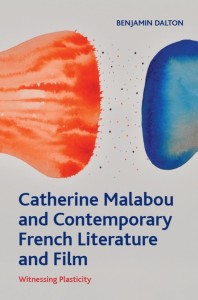
Catherine Malabou and Contemporary French Literature and Film
Witnessing Plasticity


 (0 vote)
Average rating:
| 0 | rating |  = We can do without = We can do without |
| 0 | rating |  = Good book = Good book |
| 0 | rating |  = Excellent book = Excellent book |
| 0 | rating |  = Unique / a reference = Unique / a reference |
Your rating: -
Book Presentation:
Our bodies and brains are radically transformable, mutable and plastic. From the neuroplasticity of the brain to the epigenetic malleability of our bodies and of all organic life, the work of the contemporary French philosopher Catherine Malabou invites us to consider our plasticity as both a creative resource and an ethical challenge.
This book brings Malabou’s philosophy into dialogue with contemporary literature and film. It reads conceptions of plasticity and neuroplasticity in Malabou through the mutant bodies of Leos Carax’s films; the shape-shifting bodies of Marie Darrieussecq’s novels and theatre; the terrifying, traumatic metamorphoses depicted in the fiction of Marie NDiaye; and the anarchic sexualities and identities celebrated in the cinema and writing of Alain Guiraudie. It argues that, in different ways, Malabou’s philosophy and literary and filmic texts develop modes of bearing witness to plasticity which can supplement, challenge and extend scientific understandings of biological plasticity, constituting ethical and creative sites of exploration.
About the Author:
Benjamin Dalton is Lecturer in French Studies in the School of Global Affairs at Lancaster University. His work explores intersections between contemporary French and Francophone literature and film, philosophy, and the medical and health Humanities. He has published widely on the work of Catherine Malabou, underlining the importance of her philosophy of plasticity for diverse disciplines and contexts, including contemporary literature and film; queer theory; and the medical and health humanities. Benjamin’s work also explores questions of health and care, with a particular focus on how philosophy, literature and film can help us to re-imagine the hospitals of the future. He has published a range of articles relating to this project, exploring new models for hospitals and clinical environments in the work of Catherine Malabou (Essays in French Literature and Culture, 2021 and Film-Philosophy, 2024), Jean-Luc Nancy (Nottingham French Studies, 2023), Paul B. Preciado (The Senses & Society, 2024), and Anne Dufourmantelle (Paragraph, 2024). He is founder and leader of the Queer Medical Humanities Network at Lancaster University and Co-I on the project ‘The Queer Lives of the Hospital: An Archive of LGBTQIA+ Experiences of Healthcare Environments’.
Press Reviews:
Catherine Malabou is our most important living philosopher, and this book performs an insightful intervention into contemporary film and literature using her notions of plasticity and witness. Dalton focuses our attention on French artists whose work we need to engage: Carax, Darrieussecq, NDiaye, and Guiraudie. An extraordinarily creative synthesis! -- Clayton Crockett, University of Central Arkansas
Two wonderful books in one: a concise and lucid presentation of Malabou’s philosophy followed by a series of illuminating dialogues between Malabou and four major, contemporary French filmmakers and writers (Carax, Darrieussecq, NDiaye and Guiraudie). Throughout, Dalton delineates an ethics of plasticity, revealing what art brings to Malabou’s thought, what Malabou can bring to the study of art, and what it means to listen, carefully, to the stories told across the sciences and the arts. -- Nikolaj Lübecker, University of Oxford
The depth of Malabou’s work and the finesse of Dalton’s peregrinations declare plastic moments that are just not products of investigations but intricate experiences of disciplinary conflagrations: films, stories, narrations, texts, philosophy, art, and the sciences in their variegated unfoldment. The book becomes its own witness and the floor for what I see as Dalton’s extraordinary reflections in positive plasticity. Reading Dalton is living in the plastic supplement. -- Ranjan Ghosh, University of North Bengal, India
> On a related topic:
Mists of Regret (1995)
Culture and Sensibility in Classic French Film
The History of French Literature on Film (2022)
Dir. Kate Griffiths and Andrew Watts
East-West Encounters (2003)
Franco-Asian Cinema and Literature
Cinema's Conversion to Sound (2005)
Technology and Film Style in France and the U.S.
Subject: History of Cinema
Archiving the Past (2026)
Women's Film History in France, 1927–1978
Mixed Feelings in France (2025)
White Femininity and Métissage in French Multicultural Comedy
 Back
Back

