


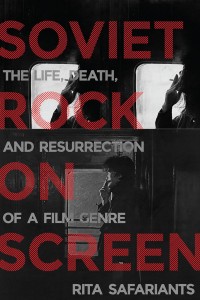
Soviet Rock on Screen
The Life, Death, and Resurrection of a Film Genre


 (0 vote)
Average rating:
| 0 | rating |  = We can do without = We can do without |
| 0 | rating |  = Good book = Good book |
| 0 | rating |  = Excellent book = Excellent book |
| 0 | rating |  = Unique / a reference = Unique / a reference |
Your rating: -
Book Presentation:
As the Iron Curtain fell and Cold War suspicions thickened in the second half of the twentieth century, the quintessentially American genre of rock and roll, seen as a potent symbol and product of an enemy ideology, quickly became a clandestine import in the USSR. The Soviet underground embraced the forbidden sounds, despite official propaganda that called rock stars social parasites and corrupting sluggards. Contrary to the regime’s desires, the genre grew in popularity until it could no longer be ignored. In the Soviet Union’s last decade, a flailing film industry, controlled by and dependent on an increasingly unstable central government, seized on the rock star as a central figure—and the Soviet rock film was born.
In Soviet Rock on Screen, Rita Safariants chronicles the birth, life, death, and resurrection of a genre that rapidly became one of the most readily recognized cultural signifiers of the perestroika era and which continues to reflect and codify Russian culture. During their initial heyday in the 1980s, rock films were influenced by and encouraged the cultural shifts of perestroika and the incipient political storm. Today, Safariants argues, the reemergence and reconfiguration of the genre indicates the extent to which Soviet-era cultural emblems inform Russian national identity and obliquely support the current political repression under Putin.
About the Author:
Rita Safariants is an assistant professor of Russian at the University of Rochester. Her work has been published in the Slavic and East European Journal, Canadian-American Slavic Studies, Studies in Russian and Soviet Cinema, and elsewhere.
Press Reviews:
"Safariants has created a new archive of texts that allow us a deeper view into the perestroika period, helping us see how the last decade of the USSR has shaped Russia’s present. A highly original contribution." -- Lilya Kaganovsky, author of The Voice of Technology: Soviet Cinema’s Transition to Sound, 1928–1935
"A fun, deeply researched, persuasively argued tour through the rise, fall, and resurrection of the Soviet rock film, a genre that played a major role in Gorbachev’s USSR and that has seen a surprising resurrection in Putin’s Russia." -- Stephen Norris, author of Blockbuster History in the New Russia: Movies, Memory, Patriotism
> On a related topic:
The New Russian Documentary (2025)
Reclaiming Reality in the Age of Authoritarianism
Dir. Masha Shpolberg and Anastasia Kostina
Subject: Countries > Russia / USSR

Modern Russian Cinema as a Battleground in Russia's Information War (2024)
Dir. Alexander Rojavin and Helen Haft
Subject: Countries > Russia / USSR
Learn Russian through Contemporary Short Film (2024)
Subject: Countries > Russia / USSR
Designing Russian Cinema (2024)
The Production Artist and the Material Environment in Silent Era Film
by Eleanor Rees
Subject: Countries > Russia / USSR

Soviet Science Fiction Cinema and the Space Age (2023)
Memorable Futures
Subject: Countries > Russia / USSR
Caught In-Between (2021)
Intermediality in Contemporary Eastern European and Russian Cinema
Dir. Agnes Petho
Subject: Countries > Russia / USSR
Performing Femininity (2021)
Woman as Performer in Early Russian Cinema
Subject: Countries > Russia / USSR
Conspiracy Culture (2020)
Post-Soviet Paranoia and the Russian Imagination
Subject: Countries > Russia / USSR
Psychomotor Aesthetics (2020)
Movement and Affect in Modern Literature and Film
Subject: Countries > Russia / USSR
 Back
Back

