


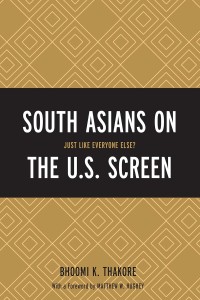
South Asians on the U.S. Screen
Just Like Everyone Else?


 (0 vote)
Average rating:
| 0 | rating |  = We can do without = We can do without |
| 0 | rating |  = Good book = Good book |
| 0 | rating |  = Excellent book = Excellent book |
| 0 | rating |  = Unique / a reference = Unique / a reference |
Your rating: -
Book Presentation:
How does the media influence society? How do media representations of South Asians, as racial and ethnic minorities, perpetuate stereotypes about this group? How do advancements in visual media, from creative storytelling to streaming technology, inform changing dynamics of all non-white media representations in the 21st century? Analyzing audience perceptions of South Asian characters from The Simpsons, Slumdog Millionaire, Harold and Kumar, The Office, Parks and Recreation, The Big Bang Theory, Outsourced, and many others, Bhoomi K. Thakore argues for the importance of understanding these representations as they influence the positioning of South Asians into the 21st century U.S. racial hierarchy. On one hand, increased acceptance of this group into the entertainment fold has informed audience perceptions of these characters as “just like everyone else.” However, these images remain secondary on the U.S. Screen, and are limited in their ability to break out of traditional stereotypes. As a result, a normative and assimilated white American identity is privileged both on the Screen, and in our increasingly multicultural society.
About the Author:
Bhoomi K. Thakore is visiting assistant professor and director of the sociology program at Elmhurst College.
Press Reviews:
"Thakore (Elmhurst College) is a sociologist, and in this book she is concerned with cultural appropriation (a term recently made current by novelist Lionel Schriver) and cultural misappropriation. Many scholars have accepted the inevitability of globalization, but others have pitched a culture war against appropriation. Thakore is on the side of the latter. First, she argues, South Asians are underrepresented. Then, when they are represented, they are stereotyped (as in the case of Slumdog Millionaire). In addition to being stereotyped, these characters are rarely three dimensional. Though Thakore comes down hard, she does not overlook work that achieves limited success. Kal Penn’s character in the television series House committed suicide but that was to free Penn up to take a job with the Obama administration. In the end, Thakore contends, in presenting South Asian characters the screen offers them not as multidimensional but as assimilated white Americans―"just like everyone else"―the current trend toward globalization notwithstanding. Thakore uses graphs and survey reports to illustrate her argument. Of interest for those interested in sociology as well as film studies. Summing Up: Recommended. Upper-division undergraduates through faculty." ―Choice Reviews
"Written in accessible prose, South Asians on the U.S. Screen is an engaging and informative text thatjoins a large body of critical race and media scholarshipon film and television, which monitors the onscreenportrayals of different racial groups andevaluates how audiences make sense of thoseimages. Updating earlier work on Asian portrayals,it provides an analysis of contemporary South Asianimages and draws meaningful comparisons withother racial groups. The book would particularlyinterest television aficionados, as well as citizensconcerned with the broader impact of immigrationon facets of everyday life, including the productionand reception of popular film and television images." ―Sociology of Race and Ethnicity
"Racialized representations in the U.S. media are not limited to ‘black and white,’ but incorporate all non-white groups. One group seldom studied as subject to racialized representations is South Asians. In South Asians on the U.S. Screen, Bhoomi K. Thakore uses data from media audiences on South Asian characters and actors and convincingly shows that most of their representations, even the ones deemed by many as "progressive," privilege white identity thus reproduce white supremacy at the semiotic level." ―Eduardo Bonilla-Silva, Duke University; author of Racism Without Racists
"Through analysis of popular South Asian characters on television as well as the responses of viewers to these representations, South Asians on the US Screen offers insights into the stereotypes that organize media portrayals of South Asians. The book will be of interest to those who want a better understanding of the role played by the US media in the marginalization of racial minorities." ―Nazli Kibria, Boston University
"This book is a fresh and analytically incisive addition to the burgeoning sociological scholarship on racial representations in the mass media. A rich mixed-methods investigation of the historic and contemporary role of South Asians (e.g., Indians) and their representations within the American mass media, Thakore’s book is an important intervention in this growing body of literature for both empirical/substantive reasons as well as the potential to develop theoretical understandings of how racial and ethnic representations operate in a colorblind/postracial society still structured by white supremacy." ―David L. Brunsma, Virginia Tech
"This book is an excellent study of the racialization of South Asian Americans. Building on the work of scholars who have documented South Asian Americans' experience with racism, this book breaks new ground by looking specifically at South Asian Americans on US screens in the 21st century. Dr. Thakore shows how depictions of South Asian Americans are used to uphold contemporary race boundaries, while US television and films appear to be inclusive of a diverse group of people . A well-researched, thoughtful book. A must read for people who are interested in understanding racism." ―Bandana Purkayastha, University of Connecticut
> On a related topic:

Gender, Ethnicity and Sexuality in Contemporary American Film (2016)
by Jude Davies and Carol R. Smith
Subject: Sociology
The Persistence of Whiteness (2007)
Race and Contemporary Hollywood Cinema
Dir. Daniel Bernardi
Subject: Sociology
Hollywood Fantasies of Miscegenation (2004)
Spectacular Narratives of Gender and Race, 1903-1967
Subject: Sociology

Black Children in Hollywood Cinema (2017)
Cast in Shadow
by Debbie Olson
Subject: Countries > United States

Race in American Film (2017)
Voices and Visions That Shaped a Nation
Dir. Daniel Bernardi and Michael Green
Subject: Countries > United States

Borderland Brutalities (2024)
Violence and Resistance Along the Us-Mexico Borderlands in Literature, Film, and Culture
Subject: Sociology
Colorization (2024)
One Hundred Years of Black Films in a White World
by Wil Haygood
Subject: Sociology
 Back
Back

