


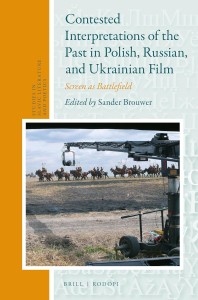
Contested Interpretations of the Past in Polish, Russian, and Ukrainian Film
Screen as Battlefield
Edited by Sander Brouwer


 (0 vote)
Average rating:
| 0 | rating |  = We can do without = We can do without |
| 0 | rating |  = Good book = Good book |
| 0 | rating |  = Excellent book = Excellent book |
| 0 | rating |  = Unique / a reference = Unique / a reference |
Your rating: -
Book Presentation:
Questions of collective identity and nationhood dominate the memory debate in both the high and popular cultures of postsocialist Russia, Poland and Ukraine. Often the 'Soviet' and 'Russian' identity are reconstructed as identical; others remember the Soviet regime as an anonymous supranational 'Empire', in which both Russian and non-Russian national cultures were destroyed. At the heart of this 'empire talk' is a series of questions pivoting on the opposition between constructed 'ethnic' and 'imperial' identities. Did ethnic Russians constitute the core group who implemented the Soviet Terror, e.g. the mass murders of the Poles in Katyn and the Ukrainians in the Holodomor? Or were Russians themselves victims of a faceless totalitarianism? The papers in this volume explore the divergent and conflicting ways in which the Soviet regime is remembered and re-imagined in contemporary Russian, Polish and Ukrainian cinema and media.
About the Author:
Sander Brouwer, Ph.D. (1995) teaches Russian literature and cultural history at Groningen University, the Netherlands. For this volume, he collected a group of specialists in Polish, Russian and Ukrainian media from the Netherlands, Poland, Ukraine, the UK and the USA.
Press Reviews:
"[T]he volume[...]convincingly [shows] how the films under review use different strategies of cinematic representation to transport interpretations of the Soviet (imperial) past in more or less subtle ways."
-Christian Noack, in Jahrbücher für Geschichte Osteuropas E-Reviews, Vol. 8, Iss. 2 (2018)
See the publisher website: Brill
> On a related topic:

Socialist Senses (2017)
Film, Feeling, and the Soviet Subject, 1917–1940
by Emma Widdis
Subject: Countries > Russia / USSR
Stalinism and Soviet Cinema (2011)
Dir. Derek Spring and Richard Taylor
Subject: Countries > Russia / USSR

Stalinist Cinema and the Production of History (2008)
Museum of the Revolution
Subject: Countries > Russia / USSR

Yellow Crocodiles and Blue Oranges (2005)
Russian Animated Film since World War II
Subject: Countries > Russia / USSR
New Soviet Man (2003)
Gender and Masculinity in Stalinst Soviet Cinema
by John Haynes
Subject: Countries > Russia / USSR
Revolt of the Filmmakers (2000)
The Struggle for Artistic Autonomy and the Fall of the Soviet Film Industry
Subject: Countries > Russia / USSR

The Red Screen (1992)
Politics, Society, Art in Soviet Cinema
Dir. Anna Lawton
Subject: Countries > Russia / USSR
Soviet Propaganda on American Screens, 1926-1940 (2026)
An Amkino Pictures Filmography
Subject: Countries > Russia / USSR
Stalin's Final Films (2024)
Cinema, Socialist Realism, and Soviet Postwar Reality, 1945-1953
Subject: Countries > Russia / USSR
 Back
Back

