


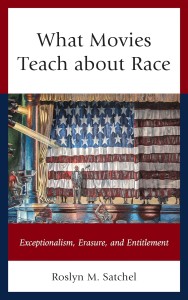
What Movies Teach about Race
Exceptionalism, Erasure, and Entitlement


 (0 vote)
Average rating:
| 0 | rating |  = We can do without = We can do without |
| 0 | rating |  = Good book = Good book |
| 0 | rating |  = Excellent book = Excellent book |
| 0 | rating |  = Unique / a reference = Unique / a reference |
Your rating: -
Book Presentation:
What Movies Teach about Race: Exceptionalism, Erasure, & Entitlement reveals the way that media frames in entertainment content persuade audiences to see themselves and others through a prescriptive lens that favors whiteness. These media representations threaten democracy as conglomeration and convergence concentrate the media’s global influence in the hands of a few corporations. By linking film’s political economy with the movie content in the most influential films, this critical discourse study uncovers the socially-shared cognitive structures that the movie industry passes down from one generation to another. Roslyn M. Satchel encourages media literacy and proposes an entertainment media cascading network activation theory that uncovers racialized rhetoric in media content that cyclically begins in historic ideologies, influences elite discourse, embeds in media systems, produces media frames and representations, shapes public opinion, and then is recycled and perpetuated generationally.
About the Author:
Roslyn Satchel is assistant professor of communication and Seaver Fellow at Pepperdine University.
Press Reviews:
"What Movies Teach about Race provides a comprehensive and insightful analysis of how racial stereotypes and images are conveyed in one of the most influential forces of socialization in our culture, the popular movie. Satchel’s work is significant not only for its contribution to critical scholarship, but also, for what it brings to contemporary conversations about race in America." ―Gary S. Selby, Pepperdine University
"This book provides a piercing critique of the racial binaries at the heart of the most influential movies in history. As Satchel deftly reveals, American film industry monopolies have, for the past four decades, rhetorically assailed global audiences with films that have collaterally championed white supremacy and American exceptionalism. This very timely investigation, which is really about the relationship between the power of film and democracy, ends with a call to researchers, educators, students, activists and audiences, but most of all to the American movie industry, to break free from the divisive formulas of racialised film, and aspire to a cinematic literacy that upholds social justice as the frame through which we see ourselves in the movies we watch." ―David C. Holmes, Monash University
"In her novel approach of examining the top ten financial grossing films of all time, Dr. Roslyn Satchel invites both media producers and audiences critically to think about the intersections of film, race and history. How is race constructed; why certain images used and others are are not; and why filmmakers and audiences are seemly comfortable with these representations are questions posed by Satchel in this fascinating study. This book will soon be a must-read for those in media, rhetorical, and critical race studies." ―Andre E. Johnson, University of Memphis
"Combining insider knowledge of the Hollywood film industry in which she worked, with academic knowledge of issues of framing, ideology, image, and message, with critical knowledge of contemporary film, Roslyn M. Satchel’s What Movies Teach about Race provides an important intervention in contemporary discussions of film and race. The manner in which Dr. Satchel describes and employs complex concepts and theories to illuminate popular Hollywood films is highly impressive. Her cinema studies display a breadth of knowledge, as well as exhibit exceptional writing talents, that make her work of interest and accessible to students, academics, and to the general public." ―Douglas Kellner, UCLA; author of Media Culture and Media Spectacle and the Crisis of Democracy
> On a related topic:

Borderland Brutalities (2024)
Violence and Resistance Along the Us-Mexico Borderlands in Literature, Film, and Culture
Subject: Sociology
Colorization (2024)
One Hundred Years of Black Films in a White World
by Wil Haygood
Subject: Sociology

Visions of Invasion (2023)
Alien Affects, Cinema, and Citizenship in Settler Colonies
Subject: Sociology

Intersecting Aesthetics (2023)
Literary Adaptations and Cinematic Representations of Blackness
Dir. Charlene Regester, Cynthia Baron and Ellen C. Scott
Subject: Sociology

White Supremacy and the American Media (2023)
Dir. Sarah D. Nilsen and Sarah E. Turner
Subject: Sociology
 Back
Back

