


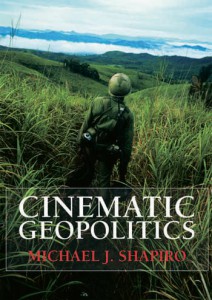
Cinematic Geopolitics


 (0 vote)
Average rating:
| 0 | rating |  = We can do without = We can do without |
| 0 | rating |  = Good book = Good book |
| 0 | rating |  = Excellent book = Excellent book |
| 0 | rating |  = Unique / a reference = Unique / a reference |
Your rating: -
Book Presentation:
In recent years, film has been one of the major genres within which the imaginaries involved in mapping the geopolitical world have been represented and reflected upon.
In this book, one of America's foremost theorists of culture and politics treats those aspects of the "geopolitical aesthetic" that must be addressed in light of both the post cold war and post 9/11 world and contemporary film theory and philosophy. Beginning with an account of his experience as a juror at film festival’s, Michael J. Shapiro’s Cinematic Geopolitics analyzes the ways in which film festival space and both feature and documentary films function as counter-spaces to the contemporary "violent cartography" occasioned by governmental policy, especially the current "war on terror."
Influenced by the cinema-philosophy relationship developed by Gilles Deleuze and the politics of aesthetics thinking of Jacques Ranciere, the book’s chapters examines a range of films from established classics like the Deer Hunter and the Battle of Algiers to contemporary films such as Dirty Pretty Things and the Fog of War. Shapiro’s use of philosophical and theoretical works makes this cutting edge examination of film and politics essential reading for all students and scholars with an interest in film and politics.
About the Author:
Michael J. Shapiro is a Professor in the Department of Political Science, University of Hawaii at Manoa, USA. His research and teaching are in the areas of political theory, global politics and cultural studies. Among his publications are: Methods and Nations: Cultural Governance and the Indigenous Subject (Routledge, 2004) and Deforming American Political Thought: Ethnicity, Facticity and Genre (University Press of Kentucky, 2006).
Press Reviews:
'Cinematic Geopolitics offers an engaging theoretical, political and historical discussion of how film is enabling a "re-mapping of the world" through the body and technology.' - Brian Faucette, Scope: An Online Journal of Film and Television Studies, October 2011
See the publisher website: Routledge
> From the same author:
> On a related topic:
Fredric Jameson and Film Theory (2022)
Marxism, Allegory, and Geopolitics in World Cinema
Dir. Keith B. Wagner, Jeremi Szaniawski and Michael Cramer
Subject: Theory

Science Fiction and Political Philosophy (2022)
From Bacon to Black Mirror
Dir. Timothy McCranor and Steven Michels
Subject: Genre > Science Fiction

House of Cards and Philosophy (2015)
Underwood's Republic
Subject: One Film > House of Cards (TV Series)

Hollywood Westerns and American Myth (2012)
The Importance of Howard Hawks and John Ford for Political Philosophy


Contemporary Screen Ethics (2025)
Absences, Identities, Belonging, Looking Anew
Dir. Lucy Bolton, David Martin-Jones and Robert Sinnerbrink
Subject: Theory

Cinecepts, Deleuze, and Godard-Miéville (2025)
Developing Philosophy through Audiovisual Media
Subject: Theory
 Back
Back

