

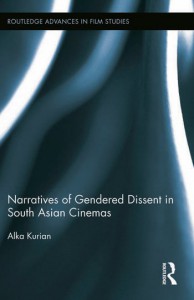
Narratives of Gendered Dissent in South Asian Cinemas
de Alka Kurian


 (0 vote)
Moyenne des votes :
| 0 | vote |  = On peut s'en passer = On peut s'en passer |
| 0 | vote |  = Bon livre = Bon livre |
| 0 | vote |  = Excellent livre = Excellent livre |
| 0 | vote |  = Unique / une référence = Unique / une référence |
Votre vote : -
Description de l'ouvrage:
This book conducts a post-colonial, gendered investigation of women-centred South Asian films. In these films, the narrative becomes an act of political engagement and a site of feminist struggle: a map that weaves together multiple strands of subjectivity—gender, caste, race, class, religion, and colonialism. The book explores the cinematic construction of an oppositional narrative of feminist dissent with a view to elaborate a historical understanding and theorisation of the ‘materiality and politics’ of the everyday struggle of Indian women. The book analyzes the ways that ‘cultural workers’ have tended to use subversive narratives as a tool of resistance. Narratives that are political, ideological, classed, raced and gendered offer the focus of this exploration. Through strategies of disclosure and documentation of memory, personal experiences, and imaginary events shaped by the larger historical, political, and cultural contexts, these discursive texts engage in the processes of struggle against a plethora of oppression: caste, class, religion, patriarchal, sexual, and (neo)colonial. The study looks at the manner in which, through their creative and aesthetic interventions, South Asian film makers enable the articulation of an alternative gendered subjectivity as well as constitute the ground for personal and collective empowerment. Films discussed include Shyam Benegal’s Nishaant, Nandita Das’ Firaaq, Beate Arnestad’s My Daughter the Terrorist, and Sarah Gavron’s Brick Lane.
À propos de l'auteur :
Alka Kurian is a Lecturer in Interdisciplinary Arts and Sciences at the University of Washington, Bothell.
> Du même auteur :
New Feminisms in South Asian Social Media, Film, and Literature (2019)
Disrupting the Discourse
Dir. Sonora Jha et Alka Kurian
Sujet : Countries > South Asia
> Sur un thème proche :
Genders and Sexualities in Indonesian Cinema (2016)
Constructing gay, lesbi and waria identities on screen
de Ben Murtagh
Sujet : Countries > Southeast Asia

Women and New Hollywood (2023)
Gender, Creative Labor, and 1970s American Cinema
Dir. Aaron Hunter et Martha Shearer
Sujet : Countries > United States
Adapting Gender (2019)
Mexican Feminisms from Literature to Film

Italy's Other Women (2016)
Gender and Prostitution in Italian Cinema, 1940–1965

Gendering the Nation (1999)
Canadian Women's Cinema
de Kay Armatage, Kass Banning, Brenda Longfellow et Janine Marchessault
Redirecting the Gaze (1998)
Gender, Theory, and Cinema in the Third World
Dir. Diana Robin et Ira Jaffe

The Third Sex (2025)
Beyond a Gender Binary in Thai Culture and Films
Sujet : Countries > Southeast Asia
 Retour