

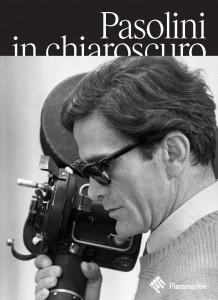
Pasolini in Chiaroscuro
by Guillaume de Sardes and Bartolomeo Pietromarchi


 (0 vote)
Average rating:
| 0 | rating |  = We can do without = We can do without |
| 0 | rating |  = Good book = Good book |
| 0 | rating |  = Excellent book = Excellent book |
| 0 | rating |  = Unique / a reference = Unique / a reference |
Your rating: -
Book Presentation:
Half a century after Pasolini’s death, his legacy still pervades the diverse creative fields in which he worked; he remains a source of inspiration for filmmakers today.
Pier Paolo Pasolini was an intellectual with a painfully lucid view of his time, acutely aware of the rise of consumerist society. Although Pasolini considered himself primarily as a writer, he was best known through his film repertoire. Cinema provided a sounding board for his political ideas, which also played a central role in his written work. Pasolini’s pluralistic approach combined poems, novels, essays, political statements, and films to create a cohesive message.
This book, and the exhibition it accompanies, demonstrates how the aesthetics of the writer-director’s films were developed and influenced through the prism of classical and contemporary art with film clips juxtaposed alongside paintings by Pontormo, Pieter Claesz, Giorgio Morandi, Fernand Léger, and Francis Bacon. It retraces Pasolini’s formative years studying art history at the University of Bologna under the guidance of Roberto Longhi. In his films, Pasolini reappropriated classical paintings in three ways: reproducing them as “living paintings” (The Deposition of Pontormo in La Ricotta); referencing them by reworking their composition or evoking striking details (Caravaggio’s Sick Young Bacchus in Accatone); or including them on set (Juan Gris’s Nature morte devant une fenêtre ouverte in Salo). To complete the book, works by thirty contemporary artists such as John Waters, Jenny Holzer, William Kentridge, Tom Burr, Marlene Dumas, Ernest Pignon-Ernest, Giovanni Fontana, and more demonstrate Pasolini’s lasting influence on the art world.
This book accompanies an exhibition held at the Nouveau Musée National de Monaco from March 29 to September 29, 2024.
About the authors:
Guillaume de Sardes is a writer, photographer, art historian, and curator. As a literary critic, he has contributed to Commentaire, Edwarda, and Service littéraire. He is editor of the Prussian Blue art magazine.
See the publisher website: Flammarion
See the complete filmography of Pier Paolo Pasolini on the website: IMDB ...
> On a related topic:
From the Arthouse to the Grindhouse (2010)
Highbrow and Lowbrow Transgression in Cinema's First Century
Dir. John Cline and Robert G. Weiner
Realism, Myth, and the Vernacular in Pasolini's Film and Philosophy (2024)
Beyond the Middle-Class Matrix
by Max Ryynänen
Subject: Director > Pier Paolo Pasolini
Against the Avant-Garde (2020)
Pier Paolo Pasolini, Contemporary Art, and Neocapitalism
Subject: Director > Pier Paolo Pasolini
Archaic Modernism (2020)
Queer Poetics in the Cinema of Pier Paolo Pasolini
Subject: Director > Pier Paolo Pasolini
Pasolini after Dante (2020)
The 'Divine Mimesis' and the Politics of Representation
Subject: Director > Pier Paolo Pasolini
Pier Paolo Pasolini, Framed and Unframed (2020)
A Thinker for the Twenty-First Century
Dir. Luca Peretti and Karen T. Raizen
Subject: Director > Pier Paolo Pasolini
 Back
Back

