

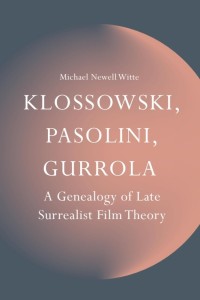
Klossowski, Pasolini, Gurrola
A Genealogy of Late Surrealist Film Theory


 (0 vote)
Average rating:
| 0 | rating |  = We can do without = We can do without |
| 0 | rating |  = Good book = Good book |
| 0 | rating |  = Excellent book = Excellent book |
| 0 | rating |  = Unique / a reference = Unique / a reference |
Your rating: -
Book Presentation:
Investigates the aesthetic philosophy of the dissident Surrealist Pierre Klossowski, shedding light on his work’s profound impact on avant-garde and neo-avant-garde aesthetics, particularly in film theory
This book explores Klossowski’s theories on art and the moving image, mapping his aesthetic philosophy within the intellectual milieu of late surrealist thought, as well as tracing its influence on a range of artists and theorists, from the Italian filmmaker Pier Paolo Pasolini to the Mexican filmmaker Juan José Gurrola, to philosophers and theorists Gilles Deleuze, J.-F. Lyotard and Juan García Ponce
This book offers a detailed map of the intellectual history that underlies the global trajectory of late surrealist thought and avant-garde/neo-avant-garde aesthetics
Through an in-depth analysis and interdisciplinary approach to the material, this book offers readers an understanding of the terrain of late surrealism in terms of its wider implications within the evolution of film theory. It generates a nuanced reading of the objects under investigation, providing new insights into the work of some of the most provocative artists and theorists of the twentieth century
Beginning with an exploration of Klossowski’s unconventional approach to literary and philosophical production, Michael Newell Witte traces the international impact that Klossowski and his cohorts in the Paris Collège de Sociologie had on the work of some of the most radical artists, filmmakers and theorists of the second half of the 20th century, with a spotlight on the critical reception of surrealist concepts within the work of the Italian film director Pier Paolo Pasolini and the Mexican filmmaker, artist and theatre practitioner, Juan José Gurrola.
By engaging with concepts like acinema, the tableau vivant, simulation, anti-economy and the theory of the instinctual drives, this book offers a fresh perspective on the evolution of avant-garde aesthetics, challenging traditional narratives and providing new insights into the complex intellectual history that underlies the fields of avant-garde film and film theory.
> On a related topic:
Indefinite Visions (2017)
Cinema and the Attractions of Uncertainty
Dir. Martine Beugnet, Allan Cameron and Arild Fetveit
Subject: Theory
Happiness and Tears, After Cavell (2025)
New Readings in Hollywood's Comedy of Remarriage and Melodrama of the Unknown Woman
Dir. Paul Deb
Subject: Sociology
 Back
Back

