

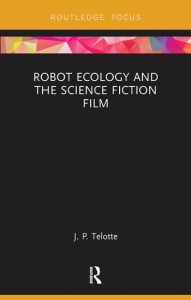
Robot Ecology and the Science Fiction Film


 (0 vote)
Moyenne des votes :
| 0 | vote |  = On peut s'en passer = On peut s'en passer |
| 0 | vote |  = Bon livre = Bon livre |
| 0 | vote |  = Excellent livre = Excellent livre |
| 0 | vote |  = Unique / une référence = Unique / une référence |
Votre vote : -
Description de l'ouvrage:
This book offers the first specific application in film studies of what is generally known as ecology theory, shifting attention from history to the (in this case media) environment. It takes the robot as its subject because it has attained a status that resonates not only with some of the key concerns of contemporary culture over the last century, but also with the very nature of film. While the robot has given us a vehicle for exploring issues of gender, race, and a variety of forms of otherness, and increasingly for asking questions about the very nature and meaning of life, this image of an artificial being, typically anthropomorphic, also invariably implicates the cinema’s own and quite fundamental artificing of the human. Looking across genres, across specific media forms, and across closely linked conceptualizations, Telotte sketches a context of interwoven influences and meanings. The result is that this study of the cinematic robot, while mainly focused on science fiction film, also incorporates its appearance in, for example, musicals, cartoons, television, advertising, toys, and literature.
À propos de l'auteur :
J. P. Telotte is a professor of film and media at Georgia Tech. Co-editor of the journal Post Script, he has published widely on film and television with a special emphasis on science fiction. Among his recent publications are The Essential Science Fiction Television Reader, Science Fiction Double Feature, and Science Fiction TV.
> Du même auteur :

The Oxford Handbook of New Science Fiction Cinemas (2023)
Sujet : Genre > Science Fiction
Science Fiction Double Feature (2021)
The Science Fiction Film as Cult Text
Dir. J. P. Telotte et Gerald Duchovnay
Sujet : Genre > Science Fiction
Movies, Modernism, and the Science Fiction Pulps (2019)
Sujet : Genre > Science Fiction
Science Fiction Film, Television, and Adaptation (2013)
Across the Screens
Dir. J. P. Telotte et Gerald Duchovnay
Sujet : Genre > Science Fiction

Voices in the Dark (1988)
The Narrative Patterns of Film Noir
> Sur un thème proche :
Amazing Worlds of Science Fiction and Science Fact (2025)
de Keith Cooper
Sujet : Genre > Science Fiction
Societies in Space (2025)
Essays on the Civilized Frontier in Film and Television
Dir. Gary Westfahl
Sujet : Genre > Science Fiction
Robots That Love (2025)
Artificial Amours in Myth, Folklore, Literature, Popular Culture and the Real World
Sujet : Genre > Science Fiction
The Future Was Now (2025)
Madmen, Mavericks, and the Epic Sci-Fi Summer of 1982
Sujet : Genre > Science Fiction
The Science Fiction Film in Contemporary Hollywood (2025)
A Social Semiotics of Bodies and Worlds
Sujet : Genre > Science Fiction
Feminist Posthumanism in Contemporary Science Fiction Film and Media (2025)
From Annihilation to High Life and Beyond
Dir. Julia A. Empey
Sujet : Genre > Science Fiction

Female Robots and AI in Science Fiction Cinema (2025)
The Fabular Femininity of Gynoids
Sujet : Genre > Science Fiction
Cyberpunk (2024)
Envisioning Possible Futures Through Cinema
Dir. Doris Berger
Sujet : Genre > Science Fiction
Fantastic Planets, Forbidden Zones, and Lost Continents (2024)
The 100 Greatest Science-fiction Films
Sujet : Genre > Science Fiction
 Retour

