

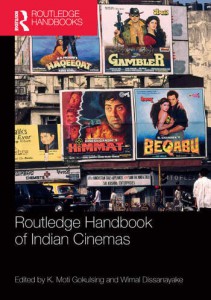
Routledge Handbook of Indian Cinemas
Edited by K. Gokulsing and Wimal Dissanayake


 (0 vote)
Average rating:
| 0 | rating |  = We can do without = We can do without |
| 0 | rating |  = Good book = Good book |
| 0 | rating |  = Excellent book = Excellent book |
| 0 | rating |  = Unique / a reference = Unique / a reference |
Your rating: -
Book Presentation:
India is the largest film producing country in the world and its output has a global reach. After years of marginalization by academics in the Western world, Indian cinemas have moved from the periphery to the center of the world cinema in a comparatively short space of time. Bringing together contributions from leading scholars in the field, this Handbook looks at the complex reasons for this remarkable journey.
Now available in paperback, the Handbook combines a historical and thematic approach to discuss how Indian cinemas need to be understood in their historical unfolding as well as their complex relationships to social, economic, cultural, political, ideological, aesthetic, technical and institutional discourses. The thematic section provides an up-to-date critical narrative on diverse topics such as audience, censorship, film distribution, film industry, diaspora, sexuality, film music and nationalism.
The Handbook provides a comprehensive and cutting edge survey of Indian cinemas, discussing Popular, Parallel/New Wave and Regional cinemas as well as the spectacular rise of Bollywood. It is an invaluable resource for students and academics of South Asian Studies, Film Studies and Cultural Studies
About the authors:
K. Moti Gokulsing is Senior Visiting Research Fellow at the University of East London, UK. He is the co-founder and co-editor of the journal South Asian Popular Culture published by Routledge. His publications include Soft-Soaping India: the world of Indian televised soap operas (2004).
Wimal Dissanayake teaches in the Academy for Creative Media at the University of Hawaii, USA. He has published widely on Indian cinema, and is co-editor of Popular Culture in a Globalised India (Routledge 2009) with K. Moti Gokulsing.
Press Reviews:
"The fresh approaches of this landmark text will no doubt serve to open up new ways of understanding this most prolific of film-producing countries." - Shamira A. Meghani, Asian Affairs
See the publisher website: Routledge
> From the same authors:
> On a related topic:
A History of India's North-East Cinema (2025)
Deconstructing the Stereotypes
Contemporary Marathi Cinema (2024)
Space, Marginality, and Aspiration
Marathi Cinema, Cultural Space, and Liminality (2022)
A History
Tamil Cinema in the Twenty-First Century (2022)
Caste, Gender and Technology
Dir. Selvaraj Velayutham and Vijay Devadas
Provincializing Bollywood (2021)
Bhojpuri Cinema in the Comparative Media Crucible
Popular Cinema and Politics in South India (2017)
The Films of MGR and Rajinikanth
Premchand in World Languages (2016)
Translation, reception and cinematic representations
Dir. M. Asaduddin
 Back
Back