


Historical Dictionary of British Cinema
by Alan Burton and Steve Chibnall

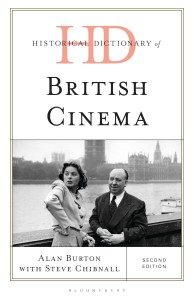

 (0 vote)
Average rating:
| 0 | rating |  = We can do without = We can do without |
| 0 | rating |  = Good book = Good book |
| 0 | rating |  = Excellent book = Excellent book |
| 0 | rating |  = Unique / a reference = Unique / a reference |
Your rating: -
Book Presentation:
British filmmakers were among the pioneers of motion pictures, and British cinema has participated in all the great historical transitions of the medium, from black and white to colour, from talkies to sound, and from flat screen to 3-D and Imax. Many British performers, artistes and directors, after success in their home country, have been lured to Hollywood, including such giants as Charlie Chaplin, Stan Laurel and Alfred Hitchcock. Today, cinema in Britain remains vibrant, turning out films that appeal to a wide variety of audiences, and initiating and sustaining such popular and lucrative series as the James Bond, Harry Potter and Bridget Jones franchises. British studios and technicians are regularly first choice for the production of Hollywood blockbusters.
Historical Dictionary of British Cinema contains a chronology, an introduction, appendices, and an extensive bibliography. The dictionary section contains cross-referenced entries on significant actors, producers, directors and crafts people, leading organizations and studios, important genres like comedy and horror, and for memorable films. This book is an excellent resource for students, researchers, and anyone wanting to know more about British cinema.
About the authors:
Alan Burton is an experienced scholar of British cinema. He has taught and researched at universities in England and Austria and published on various aspects of British film, including studies of filmmakers, genres and film movements. He is also the author of the Historical Dictionary of British Spy Fiction.Steve Chibnall, the co-author of the first edition of the Dictionary, is Professor of British Cinema at De Montfort University, Leicester, UK. He has written or edited a dozen books and journal special issues, regularly contributes booklet notes and commentaries to DVD releases, and frequently comments on aspects of British cinema on radio and television.
Press Reviews:
Part of the 'Historical Dictionaries of Literature and the Arts' series, this work by Burton (Klagenfurt Univ., Austria) and Chibnall (De Montfort Univ., UK) features brief essays, ranging from half a page to upwards of five pages, covering the lively and innovative record of British film art, production, and industry. The volume opens with a useful chronology of British cinema, beginning in 1888 and running through January 2012. The bulk of the book's contents comprise the extensively cross-referenced essays that cover directors, writers, producers, actors, films, series, characters, genres, studios, and other organizations involved in British film. The 300-plus entries are prefaced by a list of acronyms and abbreviations. Appendixes include chronological lists of the British Academy of Film and Television Arts Annual Awards, beginning in 1948; and the Evening Standard British Film Awards, starting in 1974. The book closes with a lengthy bibliography subdivided into thematic areas. The short essays are easy to read, but are nevertheless filled with historical facts and academic insight. Burton and Chibnall are established authorities on British film, with extensive records of academic publishing on film history. Summing Up: Recommended. Lower-level undergraduates through researchers. ― Choice Reviews
The British film industry, one of the world's oldest, has gone through periods of boom and bust. Two eminently qualified specialists, Chibnall, who owns a private collection of thousands of pieces of British film, and Burton, who's written extensively on silent film and directors, here describe that tortuous history beginning with a detailed chronology and following with an overview and then a dictionary section on outstanding actors, producers, directors, organizations, and studios. Among recent helpful signs, according to the authors, are lottery funding and a reputation for heritage films and literary adaptations. Lists of awards and an exhaustive bibliography complete this outstanding work. ― Library Journal
Until now, students and scholars interested in the broad scope of British cinemas had few collected sources to begin their research. . . .Together Alan Burton and Steve Chibnall have created a work of broad historical synthesis. Coupled with a chronology, a detailed and thorough introduction contextualizes Britain’s film industry within the historical confines of both national and global issues. Entries are arranged alphabetically and mostly consist of four categories: film studio, actor, film, and genre. However, broader entries such as 'women' and 'gay and lesbian issues' fill out the sociocultural development of identity within British cinema. Although varying in length, each entry averages three paragraphs. Moreover, to facilitate searching, phrases with individual entries are highlighted in bold and cross-referenced. Two appendixes are included in the dictionary: British Academy of Film and Television Arts Annual Awards, and the Evening Standard British Film Awards. . . .Ranging from silent cinema to individual journals, this robust bibliography reflects the deep subject knowledge both editors bring to the compilation. Overall, this dictionary is constructed for both the novice and expert. Students will inevitably thumb to the entry on Harry Potter, while scholars will devour the bibliography on Derek Jarman. ― American Reference Books Annual
[T]his is an engaging overview of British film which demonstrates how much this industry has contributed to worldwide cinema, and how it reflects British society and the British psyche. It would be of use not only in humanities and film collections but also a good read for all film fans. ― Reference Reviews
> From the same authors:
Looking-Glass Wars (2018)
Spies on British Screens since 1960
by Alan Burton
Subject: Countries > Great Britain

Spies on British Screens (2018)
Journal of British Cinema and Television Volume 15, Issue 3
Dir. Laura Crossley, Nicholas Barnett and Alan Burton
Subject: Countries > Great Britain
The Cinema of Basil Dearden and Michael Relph (2009)
by Alan Burton and Tim O'Sullivan
Subject: Director > Basil Dearden
> On a related topic:
Reframing Margaret Thatcher (2026)
Genre, form, and the making of post-Thatcherism in British film and TV
Subject: Countries > Great Britain
Cinema, Culture, Scotland (2025)
Selected Essays
Dir. Colin McArthur and Jonathan Murray
Subject: Countries > Great Britain
Uncanny Landscapes in 21st Century British Cinema (2025)
The Pestilence in the Ditch
Subject: Countries > Great Britain

Killing Children in British Fiction (2025)
Thatcherism to Brexit
by Dominic Dean
Subject: Countries > Great Britain
Soho on Screen (2025)
Cinematic Spaces of Bohemia and Cosmopolitanism, 1948-1963
by Jingan Young
Subject: Countries > Great Britain
Literature and Sound Film in Mid-Century Britain (2025)
Subject: Countries > Great Britain
Adult Themes (2025)
British Cinema and the X Certificate in the Long 1960s
Dir. Anne Etienne, Benjamin Halligan and Christopher Weedman
Subject: Countries > Great Britain
How Stage Playwrights Saved the British Cinema, 1930-1956 (2025)
The Well-Made Screenplay
by David Cottis
Subject: Countries > Great Britain
Beyond the BBFC (2025)
Local and regional film censorship in the UK
by Sian Barber
Subject: Countries > Great Britain
 Back
Back

