


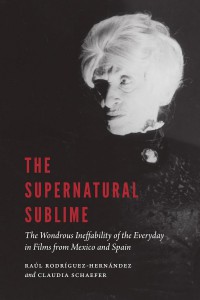
The Supernatural Sublime
The Wondrous Ineffability of the Everyday in Films from Mexico and Spain
by Raúl Rodríguez-Hernández and Claudia Schaefer


 (0 vote)
Average rating:
| 0 | rating |  = We can do without = We can do without |
| 0 | rating |  = Good book = Good book |
| 0 | rating |  = Excellent book = Excellent book |
| 0 | rating |  = Unique / a reference = Unique / a reference |
Your rating: -
Book Presentation:
The Supernatural Sublime explores the long-neglected element of the supernatural in films from Spain and Mexico by focusing on the social and cultural contexts of their production and reception, their adaptations of codes and conventions for characters and plot, and their use of cinematic techniques to create the experience of emotion without explanation. Deploying the overarching concepts of the supernatural and the sublime, Raúl Rodríguez-Hernández and Claudia Schaefer detail the dovetailing of the unnatural and the experience of limitlessness associated with the sublime.
The Supernatural Sublime embeds the films in the social histories of twentieth- and twenty-first-century Mexico and Spain, both of which made a forced leap into modernity after historical periods founded on official ideologies and circumscribed visions of the nation. Evoking Kant’s definition of the experience of the sublime, Rodríguez-Hernández and Schaefer concentrate on the unrepresentable and the contradictory that oppose purported universal truths and instead offer up illusion, deception, and imagination through cinema, itself a type of illusion: writing with light.
About the authors:
Raúl Rodríguez-Hernández is an associate professor of Spanish, comparative literature, and film and media studies at the University of Rochester. He is the author of Mexico’s Ruins: Juan Garcia Ponce and the Writing of Modernity. Claudia Schaefer is the Rush Rhees Chair and a professor of Spanish, comparative literature, and film and media studies at the University of Rochester. She is the author of several books, including Lens, Laboratory, Landscape: Observing Modern Spain and Bored to Distraction: Cinema of Excess in End-of-the-Century Mexico and Spain.
Press Reviews:
"The authors offer a provocative exploration of the conventions and aesthetics of the supernatural via close readings of selected fiction features . . . such as The Vampire (1957) and Shiver (2008). The key themes of these movies (among them, patriarchy in crisis) are fruitfully examined within the historical-sociopolitical context of the disorienting forced leap into modernity undergone by both Mexico and Spain in the 20th century. Rodíguez-Hernández and Schaefer's research is in-depth and up-to-date."—D. West, Choice
"The human psyche envisions the future in terms of hopes and fears. This volume skillfully explores the ghosts of those fears. A welcome work, indispensable for understanding the gothic supernatural in films from Spain and Mexico over six decades."—Andrés Lema-Hincapié, coeditor of Despite All Adversities: Spanish-American Queer Cinema Published On: 2018-09-21
"Finally, a long-awaited comparative examination of the supernatural in Mexican and Spanish horror and hybrid films. These case studies illuminate historical and contemporary sociopolitical problems through highly readable yet philosophical close readings grounded in film analysis. An indispensable and exciting contribution to genre studies."—Sergio de la Mora, author of Cinemachismo: Masculinities and Sexuality in Mexican Film Published On: 2018-09-21
"The pairing of Mexican and Spanish films leads to innovative readings that move beyond the framework of the national to identify the potency of supernatural tropes and motifs in posing questions about the limits of science and reason in tackling the most important themes regarding the nature and meaning of human existence. The authors bring to bear an impressive grounding in psychoanalysis, Marxist theory and analysis, and other relevant thought from a variety of fields."—Kathleen Vernon, coeditor of A Companion to Pedro Almodóvar Published On: 2018-09-21
> From the same authors:
Bored to Distraction (2003)
Cinema of Excess in End-of-the-Century Mexico and Spain
> On a related topic:
Volatile Whiteness (2025)
Race, Cinema, and Europeanization in Spain

Spanish Meta-Art and Contemporary Cinema (2025)
Mirrors to the Unconscious
Catalan Cinema (2024)
The Barcelona Film School and the New Avant-Garde
Dir. Anton Pujol and Jaume Martí-Olivella
Patriarchy's Remains (2024)
An Autopsy of Iberian Cinematic Dark Humour
 Back
Back

