


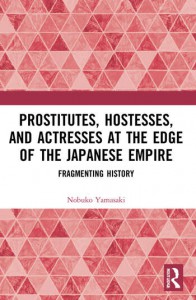
Prostitutes, Hostesses, and Actresses at the Edge of the Japanese Empire
Fragmenting History


 (0 vote)
Average rating:
| 0 | rating |  = We can do without = We can do without |
| 0 | rating |  = Good book = Good book |
| 0 | rating |  = Excellent book = Excellent book |
| 0 | rating |  = Unique / a reference = Unique / a reference |
Your rating: -
Book Presentation:
Analysing materials from literature and film, this book considers the fates of women who did not or could not buy into the Japanese imperial ideology of "good wives, wise mothers" in support of male empire-building.
Although many feminist critics have articulated women’s active roles as dutiful collaborators for the Japanese empire, male-dominated narratives of empire-building have been largely supported and rectified. In contrast, the roles of marginalized women, such as sex workers, women entertainers, hostesses, and hibakusha have rarely been analyzed. This book addresses this intellectual lacuna by closely examining memories, (semi-)autobiographical stories, and newspaper articles, grounded or inspired by lived experiences not only in Japan, but also in Shanghai, Manchukuo, colonial Korea, and the Pacific. Chapters further explore the voices of diasporic Korean women (Zainichi Korean woman born in Japan, as well as Korean American woman born in Korea) whose lives were impacted, intervening ethnocentric narratives that were at the heart of the Japanese empire. An appendix presents the first English translation of a memorable statement on comfort women by former Japanese propaganda actress, Ri Kōran / Yamaguchi Yoshiko.
Prostitutes, Hostesses, and Actresses at the Edge of the Japanese Empire will appeal to students and scholars of Japanese literature and film studies, as well as gender, sexuality and postcolonial studies.
About the Author:
Nobuko Ishitate-Okunomiya Yamasaki is an Assistant Professor at Lehigh University. She teaches at the Modern Languages and Literatures Department, as well as the Women, Gender, and Sexuality Studies Program at Lehigh.
See the publisher website: Routledge
> On a related topic:
Women in Japanese Cinema (2016)
Alternative Perspectives
Beyond the High School Film (2026)
Reaching Adulthood in Everyday Japanese Cinema
Film Viewing in Postwar Japan, 1945-1968 (2024)
An Ethnographic Study
Japanese Filmmakers in the Wake of Fukushima (2023)
Perspectives on Nuclear Disasters
Japanese High School Films (2023)
Iconography, Nostalgia and Discipline

Cinema of Discontent (2023)
Representations of Japan's High-Speed Growth
Film's Ghosts (2019)
Tatsumi Hijikata's Butoh and the Transmutation of 1960s Japan
 Back
Back

