


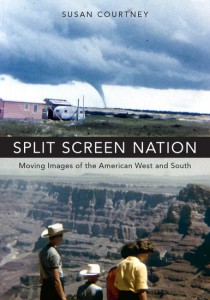
Split Screen Nation
Moving Images of the American West and South


 (0 vote)
Moyenne des votes :
| 0 | vote |  = On peut s'en passer = On peut s'en passer |
| 0 | vote |  = Bon livre = Bon livre |
| 0 | vote |  = Excellent livre = Excellent livre |
| 0 | vote |  = Unique / une référence = Unique / une référence |
Votre vote : -
Description de l'ouvrage:
• Offers new conceptual framework for thinking about region and nation in U.S. culture
• Analyzes a newly expansive archive of moving images
• Fuses diverse methods in film and media studies
Split Screen Nation traces an oppositional dynamic between the screen West and the screen South that was unstable and dramatically shifting in the decades after WWII, and has marked popular ways of imagining the U.S. ever since. If this dynamic became vivid in Quentin Tarantino's Django Unchained (2012), itself arguably a belated response to Easy Rider (1969), this book helps us understand those films, and much more, through an eclectic history of U.S. screen media from the postwar era. It deftly analyzes not only Hollywood films and television, but also educational and corporate films, amateur films (aka "home movies"), and military and civil defense films featuring "tests" of the atomic bomb in the desert. Attentive to sometimes profoundly different contexts of production and consumption shaping its varied examples, Split Screen Nation argues that in the face of the Cold War and the civil rights struggle an implicit, sometimes explicit, opposition between the screen West and the screen South nonetheless mediated the nation's most paradoxical narratives — namely, "land of the free"/land of slavery, conquest, and segregation. Whereas confronting such contradictions head-on could capsize cohesive conceptions of the U.S., by now familiar screen forms of the West and the South split them apart to offer convenient, discrete, and consequential imaginary places upon which to collectively project avowed aspirations and dump troubling forms of national waste. Pinpointing some of the most severe yet understudied postwar trends fueling this dynamic — including non-theatrical film road trips, feature films adapted from Tennessee Williams, and atomic test films — and mining their potential for more complex ways of thinking and feeling the nation, Split Screen Nation considers how the vernacular screen forms at issue have helped shape how we imagine not only America's past, but also the limits and possibilities of its present and future.
À propos de l'auteur :
Susan Courtney, Associate Professor, Film and Media Studies, University of South Carolina Susan Courtney is an associate professor of Film and Media Studies and English at the University of South Carolina. There she also co-founded the Orphan Film Symposium and has directed the program in Film and Media Studies. She is the author of Hollywood Fantasies of Miscegenation: Spectacular Narratives of Gender and Race, 1903-1967 (2005).
Revue de Presse:
Winner of the 2018 Kraszna-Krausz Best Moving Image Book Award
> Du même auteur :
Hollywood Fantasies of Miscegenation (2004)
Spectacular Narratives of Gender and Race, 1903-1967
Sujet : Sociology
> Sur un thème proche :
Filmlandia! (2023)
A Movie Lover's Guide to the Films and Television of Seattle, Portland, and the Great Northwest
Sujet : Countries > United States

Red & Black (2026)
Hollywood Left and The Blacklist
Dir. Ehsan Khoshbakht
Sujet : Countries > United States
Imagining the American Death Penalty (2025)
The Cultural Work of Popular Visual Representations
de Birte Christ
Sujet : Countries > United States
Generation Tarantino (2025)
The Last Wave of Young Turks in Hollywood
Sujet : Countries > United States
Italian Americans in Film and Other Media (2025)
The Immigrant Experience from Silent Films to the Internet Age
Dir. Daniele Fioretti et Fulvio Orsitto
Sujet : Countries > United States
 Retour

