


Great Flicks
Scientific Studies of Cinematic Creativity and Aesthetics

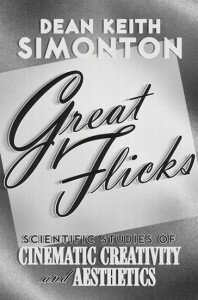

 (0 vote)
Average rating:
| 0 | rating |  = We can do without = We can do without |
| 0 | rating |  = Good book = Good book |
| 0 | rating |  = Excellent book = Excellent book |
| 0 | rating |  = Unique / a reference = Unique / a reference |
Your rating: -
Book Presentation:
• This is the first comprehensive and interdisciplinary review of what makes some films great and others much less so
• The contributing disciplines include psychology, sociology, economics, management, marketing, communications, journalism, broadcasting, history, musicology, and statistics
• Many of the findings are quite provocative
What does it take to make a great motion picture? What do we even mean by cinematic greatness? What is more important: movie awards, critical acclaim, or box office success? Who has the biggest impact: the writer, the director, or the actors? Scientific research has provided some provocative answers.
This review of cinematic creativity and aesthetics is confined to scientific studies carried out by a multidisciplinary group of researchers. Do great films receive both shiny trophies and five stars? Chapter 2 concentrates on movie awards, including the Oscars and Golden Globes, and how those awards relate to critical acclaim. How do the dramatic awards compare with the visual, technical, and music awards? Chapter 3 studies more closely how these awards cluster together and which of these clusters best predict cinematic success. How does box office compare with critical evaluations and movie awards? Chapter 4 adds a new consideration, namely the film's financial performance.
The following four chapters focus on specific contributions to a film's impact: Chapter 5 covers the script (including writers), Chapter 6 the director (or "auteur"), Chapter 7 the actors (especially gender differences), and Chapter 8 the music (both scores and songs). Chapter 9 addresses the question of whether the same cinematic factors that make some films great also make other films bad: Are bombs the exact opposite of masterpieces? The book closes with an epilogue on future directions in scientific studies of cinematic creativity and aesthetics. What do researchers need to do if we want a complete understanding of what it takes to create a powerful cinematic experience?
This volume will be invaluable to anyone interested in film, including any aficionado who is open to a scientific approach, and researchers in the areas of creativity, aesthetics, and cultural economics. The reported research comes from many disciplines, including psychology, sociology, economics, management, marketing, communications, journalism, broadcasting, history, musicology, and statistics.
About the Author:
Dr. Dean Keith Simonton, Distinguished Professor of Psychology, University of California, Davis Dean Keith Simonton (Ph.D. Harvard University) is Distinguished Professor of Psychology at the University of California, Davis. He has almost 400 publications, including 11 books, that treat various aspects of genius, creativity, leadership, and aesthetics. His numerous honors include the William James Book Award and the Rudolf Arnheim Award for Outstanding Contributions to Psychology and the Arts.
> From the same author:
> On a related topic:
A Level Film Studies (2025)
The Essential Introduction
by Sarah Casey Benyahia and John White
Subject: Film Analysis
Looking at Movies (2025)
An Introduction to Film
by Dave Monahan and Richard Barsam
Subject: Film Analysis
Cinephilia and the Adventure for Existential Health (2025)
Recomposing Subjectivity at the Cinema
Subject: Film Analysis
 Back
Back

