


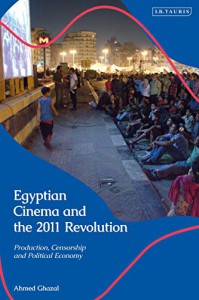
Egyptian Cinema and the 2011 Revolution
Production, Censorship and Political Economy
de Ahmed Ghazal


 (0 vote)
Moyenne des votes :
| 0 | vote |  = On peut s'en passer = On peut s'en passer |
| 0 | vote |  = Bon livre = Bon livre |
| 0 | vote |  = Excellent livre = Excellent livre |
| 0 | vote |  = Unique / une référence = Unique / une référence |
Votre vote : -
Description de l'ouvrage:
Egypt's film industry is the largest in the Middle East, with an output that spreads across the region and the world. In the run-up to and throughout the 2011 Revolution, a complex relationship formed between the industry and the people's uprising. Both a form of political expression and a documentation of historical events, 'revolutionary' film techniques have contributed to the cultural memory of 2011. At the same time, these films and their makers have been the target of increasing state control and intervention
Ahmed Ghazal, drawing upon his own background in film-making, looks at the way in which Egyptian film has shaped, and been shaped by, the events leading up to and beyond Egypt's 2011 revolution. Drawing on interviews with protagonists in the industry, analysis of films, and archival research, he analyses the critical issues affecting the political economy of the industry. He also explores the technological developments of independent productions and the cinematic themes of dictatorship, poverty, corruption and police brutality that have accompanied the people's calls for freedom - and the counterrevolution that has tried to suppress them
> Sur un thème proche :


Egyptian Male Film Stars in the Nasser Era (2026)
Envisioning a National Identity
Sujet : Countries > Middle East
Understanding the Public Sector in Egyptian Cinema (2024)
A State Venture
Sujet : Countries > Middle East
Representations of Palestine in Egyptian Cinema (2023)
Politics of (In)visibility
Sujet : Countries > Middle East

Egypt 1919 (2022)
The Revolution in Literature and Film
de Dina Heshmat
Sujet : Countries > Middle East


Film and Counterculture in the 2011 Egyptian Uprising (2021)
de Amir Taha
Sujet : Countries > Middle East
 Retour

