


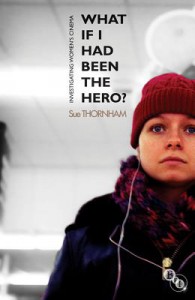
What If I Had Been the Hero?
Investigating Women's Cinema
by Sue Thornham


 (0 vote)
Average rating:
| 0 | rating |  = We can do without = We can do without |
| 0 | rating |  = Good book = Good book |
| 0 | rating |  = Excellent book = Excellent book |
| 0 | rating |  = Unique / a reference = Unique / a reference |
Your rating: -
Book Presentation:
Sue Thornham's study explores issues in feminist filmmaking through an examination of a wide range of films by women filmmakers, ranging from the avant-garde to mainstream Hollywood, and from the 1970s to the present day, discussing directors including Sally Potter, Jane Campion, Julie Dash, Patricia Rozema and Lynne Ramsay.
What happens when women tell their own stories in film? In What If I Had Been the Hero?, Sue Thornham addresses this question through an exploration of a wide range of films, from experimental feminist film to mainstream Hollywood, and from the 1970s to the present day, by filmmakers including Sally Potter, Jane Campion, Deepa Mehta, Patricia Rozema and Lynne Ramsay.
Her discussion takes in films from India and Argentina as well as Europe, Canada, Australia and the US. Not content to take the 'post feminist' makeover film or the figure of the 'action chick' as evidence of women's increased power and status, Sue Thornham raises key issues about women as authors, subjects and heroes of their narratives. She argues that simple reversals of gendered positions of hero/heroine, active/passive, and subject/object are not enough.
Drawing on a wide range of feminist theoretical sources, What If I Had Been the Hero? makes an important intervention into contemporary debate, situating filmmaking within a rich history of female creativity, and insisting on the continuing importance of feminist theory.
About the Author:
SUE THORNHAM is Professor of Media and Film and Head of School at the University of Sussex, UK. She is the author of Passionate Detachments: An Introduction to Feminist Film Theory (1996), Feminist Theory and Cultural Studies (2001) and Women, Feminism and Media (2007); the co-author, with Tony Purvis, of Television Drama: Theories and Identities (2005); the editor of Feminist Film Theory: A Reader (1999), and the co-editor, with Caroline Bassett and Paul Marris, of Media Studies: A Reader (3rd edition 2009).
> From the same author:

Spaces of Women's Cinema (2019)
Space, Place and Genre in Contemporary Women's Filmmaking
by Sue Thornham
Subject: Sociology
> On a related topic:
Heightened Genre and Women's Filmmaking in Hollywood (2022)
The Rise of the Cine-fille
by Mary Harrod
Subject: Sociology
On Women's Films (2019)
Across Worlds and Generations
Dir. Ivone Margulies and Jeremi Szaniawski
Subject: General
Women Do Genre in Film and Television (2019)
Dir. Mary Harrod and Katarzyna Paszkiewicz
Subject: Sociology
Feminist Visions (2026)
Tracing Feminist Epistemologies in Contemporary Film and Television
Dir. Hélène Charlery and Cristelle Maury
Subject: Sociology
Sustainable Resilience in Women's Film and Video Organizations (2024)
A Counter-Lineage in Moving Image History
Subject: Sociology
There She Goes Again (2023)
Gender, Power, and Knowledge in Contemporary Film and Television Franchises
Subject: Sociology
Independent Women (2023)
From Film to Television
Dir. Claire Perkins and Michele Schreiber
Subject: Sociology
 Back
Back

