

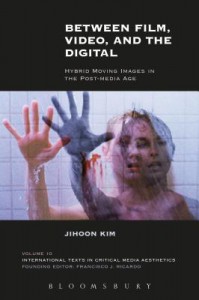
Between Film, Video, and the Digital
Hybrid Moving Images in the Post-Media Age
by Jihoon Kim


 (0 vote)
Average rating:
| 0 | rating |  = We can do without = We can do without |
| 0 | rating |  = Good book = Good book |
| 0 | rating |  = Excellent book = Excellent book |
| 0 | rating |  = Unique / a reference = Unique / a reference |
Your rating: -
Book Presentation:
Encompassing experimental film and video, essay film, gallery-based installation art, and digital art, Jihoon Kim establishes the concept of hybrid moving images as an array of impure images shaped by the encounters and negotiations between different media, while also using it to explore various theoretical issues, such as stillness and movement, indexicality, abstraction, materiality, afterlives of the celluloid cinema, archive, memory, apparatus, and the concept of medium as such.
Grounding its study in interdisciplinary framework of film studies, media studies, and contemporary art criticism, Between Film, Video, and the Digital offers a fresh insight on the post-media conditions of film and video under the pervasive influences of digital technologies, as well as on the crucial roles of media hybridity in the creative processes of giving birth to the emerging forms of the moving image. Incorporating in-depth readings of recent works by more than thirty artists and filmmakers, including Jim Campbell, Bill Viola, Sam Taylor-Johnson, David Claerbout, Fiona Tan, Takeshi Murata, Jennifer West, Ken Jacobs, Christoph Girardet and Matthias M ller, Hito Steyerl, Lynne Sachs, Harun Farocki, Doug Aitken, Douglas Gordon, Stan Douglas, Candice Breitz, among others, the book is the essential scholarly monograph for understanding how digital technologies simultaneously depend on and differ film previous time-based media, and how this juncture of similarities and differences signals a new regime of the art of the moving image.
About the Author:
Jihoon Kim is Assistant Professor in the Department of Film Studies at Chung-ang University, South Korea, after teaching in the Division of Broadcast and Cinema Studies at Wee Kim Wee School of Communication and Information, Nanyang Technological University, Singapore. His essays have appeared in Screen, Film Quarterly, Animation: An Interdisciplinary Journal, Millennium Film Journal, Leonardo Electronic Almanac, and the anthologies Global Art Cinema: New Histories and Theories (2010), and Taking Place: Location and the Moving Image (2011), among others.
> From the same author:
Documentary's Expanded Fields (2022)
New Media and the Twenty-First-Century Documentary
by Jihoon Kim
Subject: Genre > Documentary
> On a related topic:
Performative Images (2023)
A Philosophy of Video Art Technology in France
by Anaïs Nony
Subject: Genre > Experimental
After Uniqueness (2017)
A History of Film and Video Art in Circulation
by Erika Balsom
Subject: Genre > Experimental
Experimental Cinema (2026)
Structures, Systems and Strategies
by Simon Payne
Subject: Genre > Experimental
Italian Experimental Cinema and Moving-Image Art (2025)
New Paths, New Perspectives
Dir. Rossella Catanese and Jennifer Malvezzi
Subject: Genre > Experimental
 Back
Back

